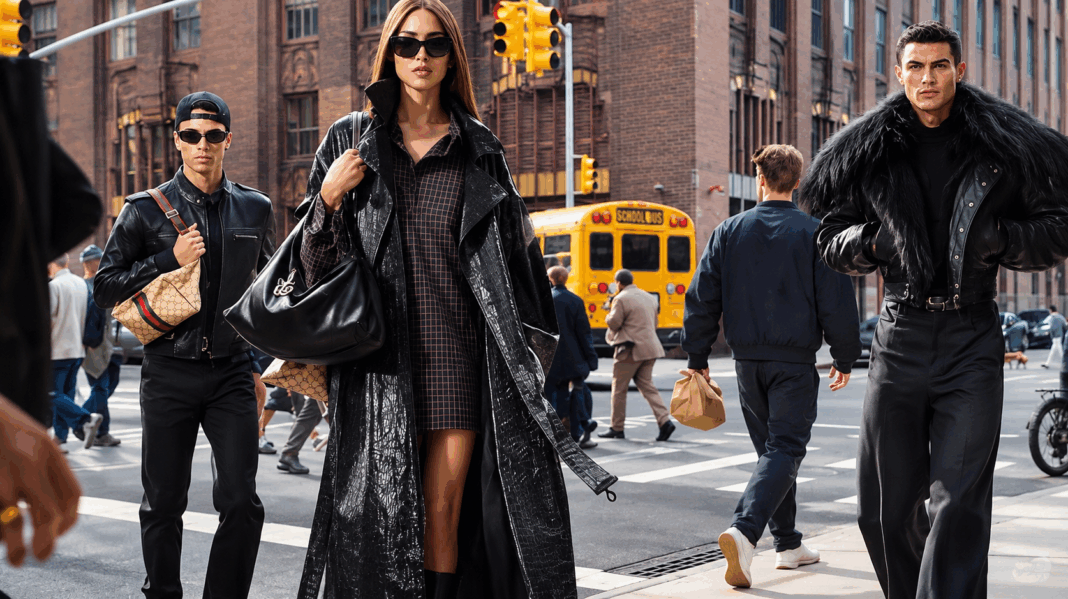
Gucci has returned to the city that first carried its name beyond Italy, and this time it has done so on foot. In late October, the House unveiled GucciCore, a campaign photographed by Peter Funch across the crosswalks and corners of New York, arriving five months after Demna shut down the center of Times Square for his debut Cruise show. The images are not a runway rendered in miniature but something quieter and stranger: a procession of strangers caught mid-stride, each dressed in a wardrobe the House now treats as its foundation rather than its flourish.
Funch was the correct instrument for this idea, and anyone familiar with his work understood why the moment his name appeared. For nine years, between 2007 and 2016, he stationed himself at the corner of 42nd Street and Vanderbilt Avenue, photographing the same commuters as they passed the same spot at different hours and in different weather, assembling a study of how people repeat and revise themselves inside a crowd. GucciCore extends that obsession into couture, gathering eclectic clusters of New Yorkers, the office worker and the socialite, the tourist and the shopkeeper, and letting their contradictions sit beside one another without resolution.
What they are wearing is deliberately, almost defiantly, ordinary. The collection foregrounds the peacoat, the trench, the sharp business suit, the crisp shirt and the pencil skirt, garments a person reaches for without thinking, now cut and weighted with Italian glamour so that the thinking becomes unavoidable. It continues the argument Demna has built since arriving from Balenciaga: that Gucci’s future lies less in spectacle than in the clothes people actually put on. The La Famiglia lookbook introduced the thesis, the 2025 short film The Tiger dramatized it, and GucciCore, shot against the grey and neon of midtown, makes it feel like a civic fact.
The stakes behind that restraint are not small. Demna inherited a House under pressure, its parent company Kering having reported a sharp sales decline in the quarter before his Milan debut, and his brief has been stated plainly from the top. “Our priority is to make Gucci unmissable again,” Kering’s chief executive said this spring, a sentence that reads less like ambition than instruction. The Times Square show answered it at maximum volume, a street closed between 46th and 48th, every billboard converted into a live feed, Cindy Crawford closing in black feathers while Tom Brady and Paris Hilton walked the same asphalt.
GucciCore is the morning after, and it is the more interesting gesture. Where the runway shouted, the campaign observes. Demna had wanted to do the impossible, to place Gucci “at the center of this metropolis,” and the campaign is what happens once the impossible has been achieved and the fences come down. The House calls the result a portrait of plurality, marketing language for an idea that is actually quite sincere: that a luxury brand might express its identity most convincingly by making room for everyone else’s.
New York matters here as more than backdrop. Gucci opened its first store outside Italy on Fifth Avenue in 1953, and the city has served as the brand’s American conscience ever since, the place where Italian fantasy meets a harder, faster, more democratic kind of style. There is a commercial intelligence running beneath the romance, too. Essentials sell, and they sell repeatedly, in a way a feathered gown never will. By anchoring desire to the peacoat and the pencil skirt, photographed on bodies that resemble the people riding the subway rather than the ones on the billboards above it, Gucci is quietly rebuilding the kind of wardrobe a customer returns to season after season.
What lingers, after the images stop scrolling, is the duality the title promises. New Yorkers spend their lives performing belonging and distinction at once, dissolving into the crowd and insisting on themselves within it. Funch has always understood that the two are the same gesture. GucciCore, at its best, understands it too.