
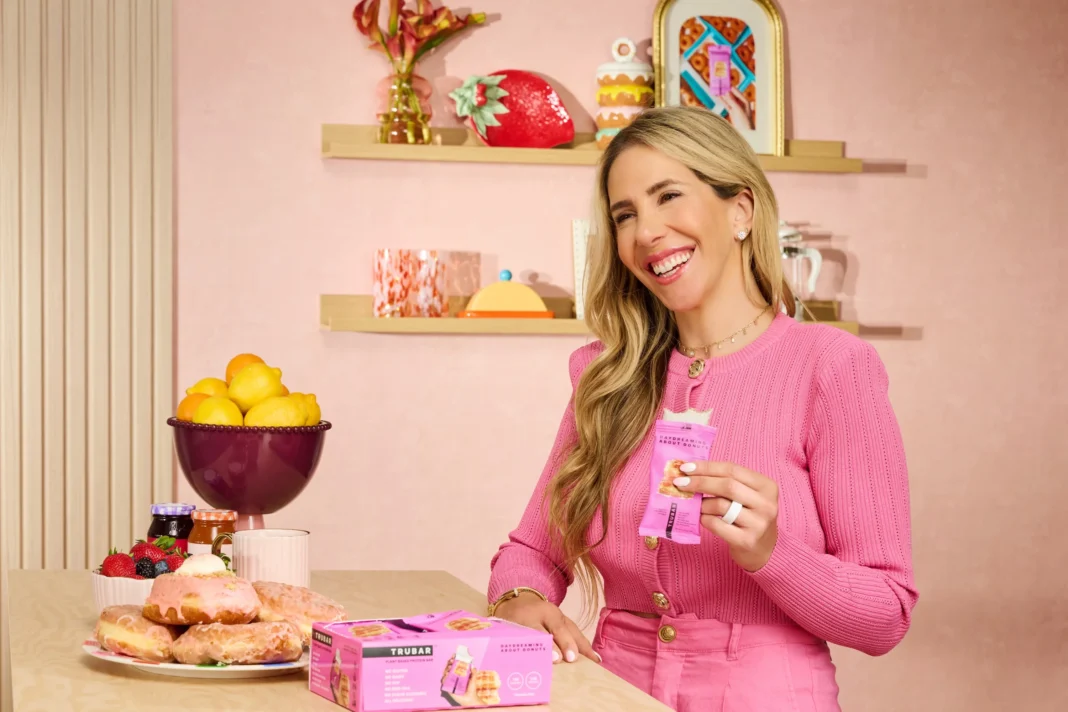
The wooden tray came from Bed Bath & Beyond. On it sat a handful of protein bars and a proposition modest enough that it barely qualified as a pitch: leave these by the register, and see whether anyone reaches for them. People did. They came back for more. Seven years later, that counter experiment has a name, Trubar, a presence in roughly 32,000 American retail locations, and a valuation to match. In early 2026, the Turkish snack conglomerate Eti Gida acquired the company outright for $173 million in cash, with no earn-out. Erica Groussman, the stay-at-home mother who built it, remains its chief executive, and remains, by her own insistence, nowhere near finished.
The idea arrived the way most durable ones do, through discomfort. On a family trip to Disney, Groussman had packed a protein bar from an established brand. It tasted fine. What followed did not. “I remember just feeling very ucky,” she says. “My belly was very distended and uncomfortable. That was my epiphany. There has to be a better way.” The standard she set for herself was deceptively hard: a bar that ate like dessert and left none of the aftermath she had come to expect from the category.
Nothing in her résumé pointed toward food. A newspaper route her mother handed her as a child taught her early that money followed showing up. She studied communications at UCLA, worked in film finance and then real estate, married, and had two children. The company began in the margins of motherhood. To build the product, she found a food scientist through research and her own network, and approached development as a sensory discipline she still practices. “We’ll taste the bar, and I’ll say what I taste,” she says. “What am I getting afterwards? What’s the aftertaste? What do I want to see more of? Do I want more crunchy?”
Trubar launched in 2018 with Groussman as chief executive and a lineup built for appetite rather than apology: Daydreaming About Donuts, Oh Oh Cookie Dough, Saltylicious Almond Love, Smother Fudger Peanut Butter. Cookie dough sold first and fastest. Her proof of concept was literal. She placed bars on any counter that would have them, juice shops, delis, salons, corner stores, letting owners set their own prices, usually three or four dollars, and watched whether the stock moved. “That’s how I knew it was good,” she says. “People were buying them and then asking to buy more.”
The first near-fatal lesson came from delegation. Stretched between the company, two children, and a house under construction, Groussman brought in an outside operator she believed knew the business better than she did. His spending outran the young company’s sales, and the arrangement left Trubar roughly $7 million in debt. Her husband urged her to call it a loss. She refused. “It’s a part of me,” she recalls telling him. “I really want to keep it going.” The episode rearranged her sense of her own authority. “I knew more than I thought I knew,” she says. “We always doubt ourselves.”
What followed was recovery by persistence. A contact pursued doggedly on LinkedIn opened a trial at thirty Whole Foods locations around 2020, where Trubar, carrying no marketing budget, outsold established names like RXBAR and Kind. That detail reads differently in 2026 than it did then: Mars has since absorbed both brands, folding RXBAR into the portfolio that already held Kind, which makes the better-for-you aisle less a scrappy frontier than a field of conglomerates. A first run at Costco in Canada faltered, undercut by unfamiliarity and price positioning. The American rollout, when it came, did not.
The corporate chapters were messier than the shelf ones. In 2021 Trubar was folded into a publicly traded holding company whose portfolio also included skincare and CBD ventures, a structure Groussman accepted because it funded growth without personal debt. The other businesses failed; hers, she says, was quietly underwriting them even as it gained traction. By 2024 she was the last one standing, and became chief executive of the public company itself. “I was the only one standing,” she says. “I was a CEO of a publicly traded company.”
Her management style stayed stubbornly close to the ground. With a team of roughly 28, she treats her own availability as a rule. “I will not ask you to do something that I wouldn’t do myself,” she says. When a Walmart launch shipment threatened to arrive late, she worked the phones until she found a packager who could deliver in two weeks. When a box went out mislabeled, almonds and cashews transposed on the front, the team bought green stickers from nearby Staples locations and corrected each one by hand before delivery, then traced the failure afterward. Her operating creed is to act first and diagnose second. “Just get 80%, just go,” she says. On hiring: “You interview for your résumé; you hire for chemistry.”
The Eti Gida deal, for her, is a beginning dressed as a milestone. The buyer is no newcomer: a family-owned manufacturer founded in 1961, running nine plants, employing some 8,500 people, and selling more than 300 products across biscuits, chocolate, and savory snacks. “Welcoming Trubar into the Eti family is a strategic step,” chairman Firuzhan Kanatli said of the acquisition, which keeps Groussman and her team in place, the one condition she treated as non-negotiable. Trubar Kids arrived last year; Trubar Pro followed; more categories, she suggests, are coming. “I’m not done,” she says. “It’s my baby.”