
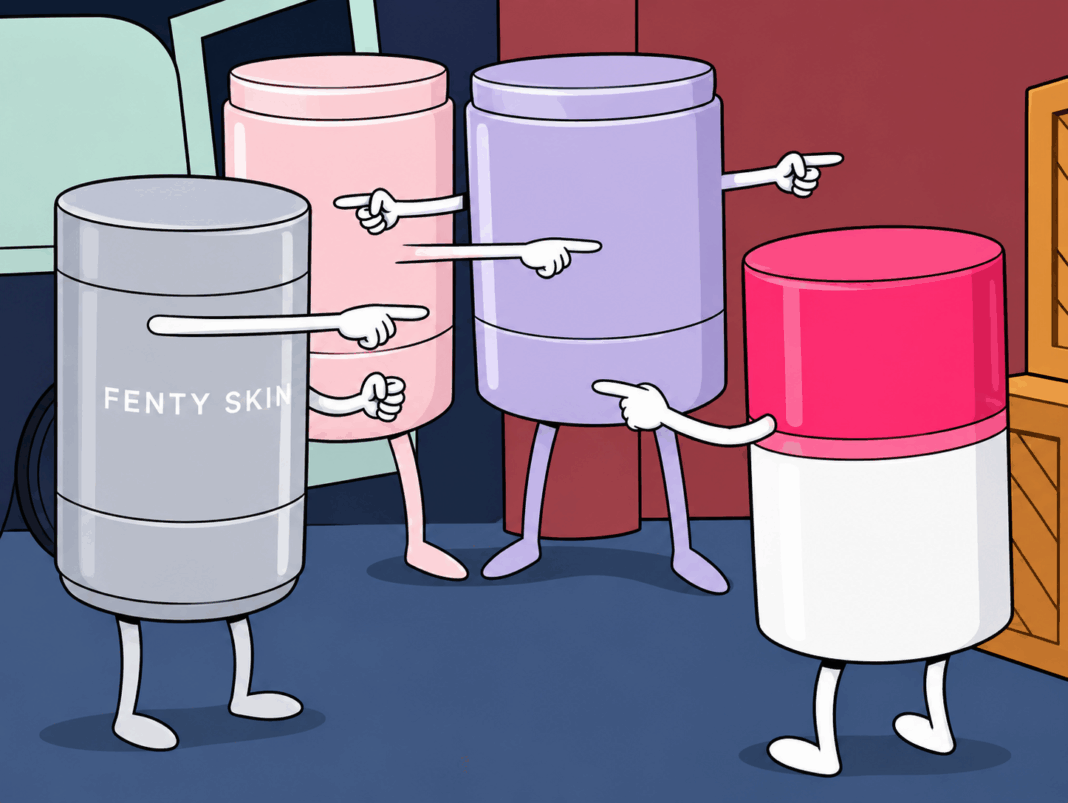
The beauty internet rarely resists a whodunit, and for one frantic stretch this autumn it believed it had cornered three suspects at once. When Fenty Skin, Glow Recipe and Huda Beauty each surfaced with a hydrogel under-eye patch housed in the same grinder-style dispenser, the kind that twists to release a fresh slice of gel with every use, the question wrote itself across TikTok and Instagram: who copied whom? Fenty Skin had teased its Dew N Plump Fresh-Sliced Hydrogel Eye Patches on September 17, and Glow Recipe followed within days with its Exopeptide Caffeine Brighten and Depuff Fresh Slices Eye Mask, while Huda Beauty’s own under-eye jelly patches completed the trio fans swiftly christened “Eye Patch Gate.” The visuals were close enough to feel like a prank. The explanation, according to the founders themselves, is far less cinematic.
Huda Kattan was among the first to reframe the pile-on, pointing not at her peers but at a shared vendor. “I think it’s pretty obvious that we all got screwed over by the same packaging supplier,” she said. “Formulas are different, but we were lied to on the exclusivity with the packaging supplier, pretty crazy.” It is a claim that lands differently once you understand how beauty actually gets made, where the distance between a container and its contents is wider than most shoppers ever imagine.
That distance is exactly what Allyse Cirillo, founder and CEO of SAINT JŌ, wants consumers to sit with. “One of the biggest misconceptions consumers have about product development is that being first to market means you were first to develop. It doesn’t,” she says. “Products can be in development for [up to] 24 months before a consumer ever sees them, and multiple brands can be developing around the same emerging technology simultaneously.” By that logic, the race fans were scoring in real time had most likely been run years earlier, quietly and in parallel, by teams who never once saw one another’s work.
Cirillo is careful to puncture the drama without dismissing the confusion that fueled it. “When three recognizable brands appear with nearly identical packaging within days of each other, the immediate assumption on social media is naturally going to be, ‘Who copied whom?’ The reality of product development can be much less dramatic,” she says, citing shared suppliers, stock packaging, overlapping timelines and emerging manufacturing technologies as the unglamorous forces that routinely deliver rival brands to the same doorstep independently.
The hunt for a true originator inevitably turned east. Commenters noted that K-beauty label Wonder Bath had been selling its Slice Serum Eye Patches since July, using the very mechanism the three Western brands would later tease. But Kira Piskalova, co-founder of Beyond Facials, cautions against crowning any single name. “Korean packaging manufacturer Samhwa holds patents for rotating and grinding cosmetic containers and is publicly listed as the manufacturer of a closely similar grind-cut hydrogel eye-patch dispenser,” she says. “That suggests the relevant mechanism existed within a broader Korean packaging ecosystem rather than originating entirely with one beauty brand at launch.” The format, in other words, belongs to an industry, not an author.
What might have calcified into a feud instead dissolved into content. Rather than lawyer up, Fenty Skin posted a Spider-Man-style meme lining the look-alikes up side by side, and Huda Beauty wandered into the comments with “great minds think alike,” while Wonder Bath turned up in equally good humor to welcome everyone to the category. The collective shrug says something about where beauty sits in 2026, a visual-first economy in which a packaging coincidence can generate more engagement than any serum claim, and in which brands increasingly understand that leaning into a moment beats litigating it.
Whether the gimmick survives its own virality is another question entirely. Piskalova expects the novelty to fade the way earlier innovations did. “I suspect many consumers will eventually move on, especially if the format becomes more common and products differentiate themselves through formulas, claims and performance,” she says, likening the twist-to-slice dispenser to the airless pump, “once marketed as a premium experience,” now so ubiquitous across prestige and drugstore shelves that it barely registers as special.
The sharper takeaway may be a reminder that spectacle and substance are not the same purchase. “I would be cautious about assuming that [the self-cutting mechanism] automatically means greater skincare efficacy,” Cirillo says. “That’s an important distinction in beauty right now. Something can be genuinely innovative from a packaging and experience perspective without necessarily being a formulation breakthrough.” Eye Patch Gate, then, was never really about who got there first. It was a brief, revealing lesson in how the industry manufactures desire, and how easily a clever container can be mistaken for a cure.