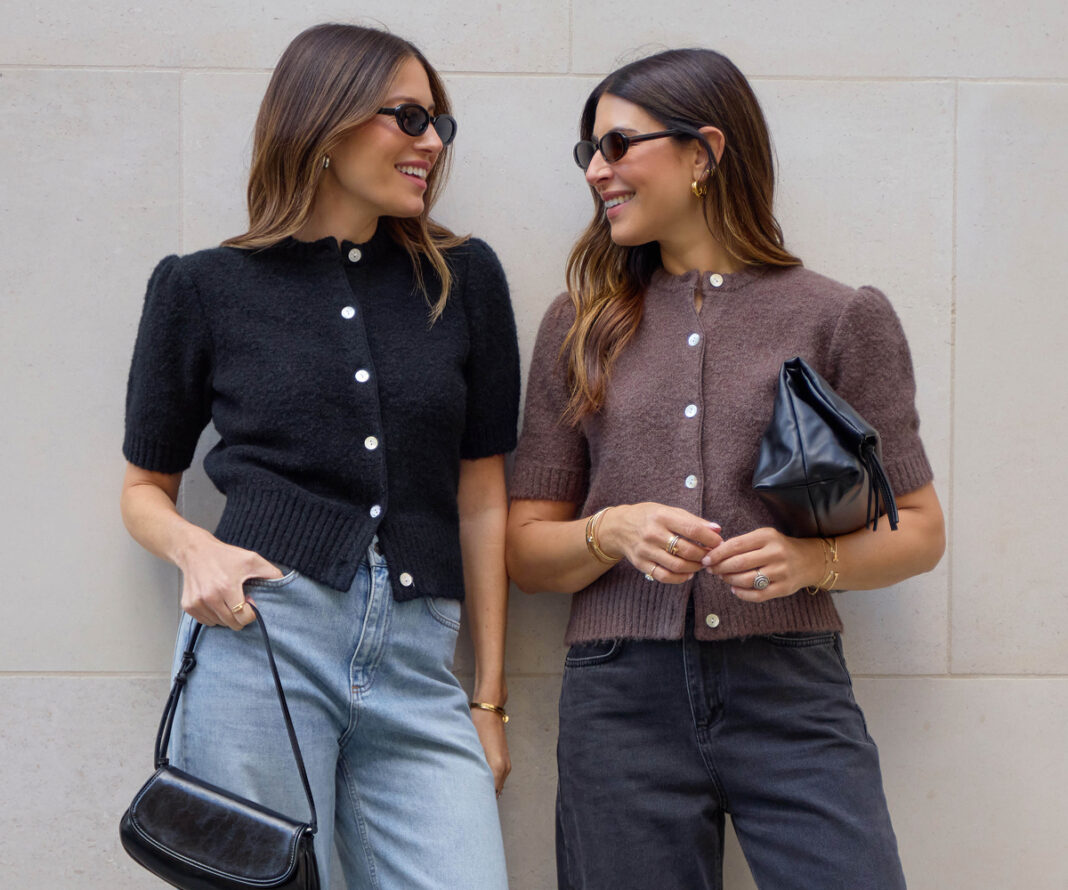
Seventeen years ago, two fashion stylists found themselves in the same room at a Marks & Spencer press day, dressed, improbably, in the same outfit. Sarah Ellis and Philippa Ross would go on to uncover a near-comic tally of coincidences, identical first jobs, fathers who shared a name, grandparents who had once been friends, but the coincidence that matters now is a commercial one. The retailer that first introduced them has become the debut wholesale partner for the womenswear label they built together, WAT The Brand. This September, the London duo known to more than 800,000 Instagram followers as We Are Twinset arrived at M&S, closing a loop that began long before either woman had heard the word influencer attached to a job description.
That WAT should land at M&S first carries a particular weight, because the retailer was also the pair’s very first paid brand collaboration as content creators. The partnership is, in the truest sense, a full-circle moment, and it is tempting to read it purely as sentiment. It is not. We Are Twinset began in 2014 as a blog and an Instagram account built on a simple premise: show women not just what to buy but how to actually wear it. Over the following decade, Ellis and Ross turned that premise into one of Britain’s most trusted style platforms, and in the process they accumulated something more valuable than reach. They accumulated data about desire. “We had spent years of understanding what our community actually wanted from their wardrobes,” the pair explain, “and eventually thought, why aren’t we creating it ourselves?”
The answer arrived in 2021, in the unlikeliest of conditions. WAT The Brand, its name an acronym for We Are Twinset, launched mid-lockdown with a twelve-piece capsule of luxe loungewear, the slate-grey crewnecks and carefully cut joggers that an entire housebound country suddenly wanted. It sold out, and the momentum carried the label from one category into the next: dresses, footwear, knitwear, even a children’s Mini Me line for mothers who wanted to match their daughters. To translate an influencer’s instinct into a functioning retail operation, the founders brought in Nicky Green, whose buying career spans Kurt Geiger, River Island and My 1st Years. Green remains a co-founder, the third point in a triangle that pairs editorial fluency with commercial discipline.
What distinguishes WAT from the crowded field of creator-led brands is the specificity of its proposition. These are not vanity drops. The label trades in what Ellis and Ross call elevated, effortless staples, the pieces a wardrobe leans on rather than the ones it photographs once. The M&S edit reflects that ethos in its pricing: a ribbed T-shirt at £35, joggers at £55, a bouclé cardigan at £78, a maxi coat at £200. It is an accessible luxury register, aspirational without being remote, and it slots neatly into the retailer’s own reinvention as a destination for considered, contemporary fashion rather than dependable basics alone.
The timing is notable for another reason. Ellis and Ross are candid that fashion has been a challenging market to trade in over the past twelve months, a stretch in which several direct-to-consumer darlings have stumbled or folded. WAT, by contrast, has kept growing. In the fourth quarter of its most recent financial year, sales rose 37 percent year on year, the kind of figure that reframes a founder story from charming to serious. Wholesale, and specifically a partner with the footprint of M&S, is how a digitally native label reaches the customer who browses in person, trusts a familiar name, and may never have encountered We Are Twinset at all. The brand is now available online at M&S and through click-and-collect.
There is a larger shift embedded in all of this, one the industry is still learning to price. The first generation of fashion influencers was built to sell other people’s products. The most clear-eyed of them are now building their own, and the distance between a sponsored post and a sell-through sheet turns out to be shorter than anyone assumed. Ellis and Ross spent a decade learning exactly what their audience would reach for, and WAT The Brand is that thesis made tangible. That it now hangs, both literally and figuratively, in the retailer where their whole story started is the sort of symmetry a scriptwriter would reject as too neat. In fashion, occasionally, the neat version is also the true one.