On the afternoon of September 10, the Palm Court at The Plaza Hotel stopped serving tea and started serving a runway. Tommy Hilfiger, seventy-five years old and New York born, lived in a duplex penthouse inside this building for more than a decade with his wife, Dee, and for Spring/Summer 2027 he returned to it as host rather than resident. Gigi Hadid opened in cherry-red trousers, a tan jacket and a navy bucket hat. Romeo Beckham closed. Between them, violinists worked their way through “Empire State of Mind,” and the designer’s thesis for the season arrived without decoration: “New York is back.”
A day earlier, at the brand’s Madison Avenue headquarters, the scale of what he has built was visible from the sidewalk. A flag carrying the instantly legible red, white and blue emblem snaps above the entrance of a twenty-six floor tower, which is a reasonable metaphor for a label that went from ambitious menswear newcomer in the early 1980s to one of the most recognizable names on earth in under fifty years. Address him formally inside those walls and he will correct you, kindly. “Call me Tommy.”
The Plaza is not a neutral venue for him, which is precisely the point. He and Dee took two units at the top of the hotel in 2008, combined them into a home of more than six thousand square feet, and lived beneath a domed ceiling painted with an Eloise mural by Hilary Knight, the illustrator who turned the building into a children’s-book landmark. What he remembers most is what sat outside the window. “It was like living in the country,” he said of the park. He remembers the traffic downstairs too, the rotating cast of Hollywood names, athletes, musicians and families moving through the lobby, and the residue all of it leaves behind. “There’s something about it that has that charisma,” he said.
That mix functioned as the casting brief for the audience as much as for the collection. Kate Moss sat front row near Camila Cabello and JISOO. Knicks players Karl-Anthony Towns, Josh Hart and Miles McBride held the sporting wing, with Carmelo Anthony nearby, while Patrick Schwarzenegger and Jordyn Woods filled out the rest of the room. The finale belonged to Slayyyter, the electro-pop provocateur, performing head to toe in Hilfiger and putting an edge on an afternoon that could otherwise have coasted on heritage. None of it read as rented celebrity. Hilfiger has spent four decades in genuine conversation with cultural tastemakers rather than in pursuit of them.
The method has a founding date. In 1994, Snoop Dogg came through the Hilfiger showroom and left in a rugby shirt he wore days later onto “Saturday Night Live,” and the run on that style taught the designer something the industry took another twenty years to formalize: clothing travels furthest when it is attached to a performance. He has called the approach fashiontainment ever since, and every element of the Plaza show, from the string arrangement to the pop set, descends from that night.
The clothes come from an older decision. He began designing his debut collection in 1984 and launched in 1985, taking the prep uniform he had grown up inside and loosening its grip. “Why don’t I take this prep and remix it?” he recalled thinking. Oversized, relaxed, detailed differently, offered to people the category had never bothered to court. Prep remains what he calls “the backbone of the brand,” though he has never treated it as a fixed text.
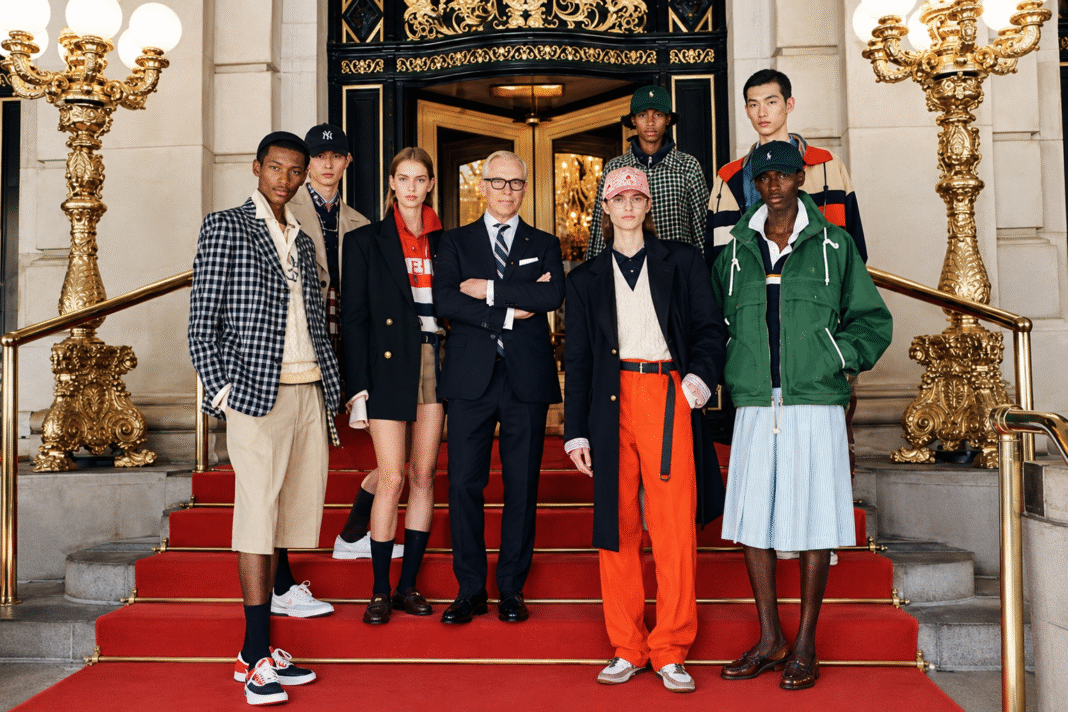
Spring/Summer 2027 continues the line the brand has named Prep Made Current, and it plays as a character study of the Plaza lobby itself. Ivy jackets and Oxford shirts returned in unfamiliar prints and saturated color. Rugby shirts were cut into dresses, color-blocked, blown up with outsized logos. Tartan arrived as windbreakers, standing-collar jackets, cargo shorts and bucket hats, while Ithaca stripes ran across shirting and deconstructed tops. The palette held to red and navy with the conviction of a flag. Hilfiger closed the show walking the runway with a dog.
Prep’s current revival is not a Hilfiger invention, but few houses are better positioned to meet it, and fewer still can stage it inside a building they once lived in. What the Plaza afternoon argued, with more force than any press release could, is that American heritage labels do not have to choose between the archive and the present tense. “New York is back,” he said. On September 10, in a room he used to live above, it was difficult to disagree.