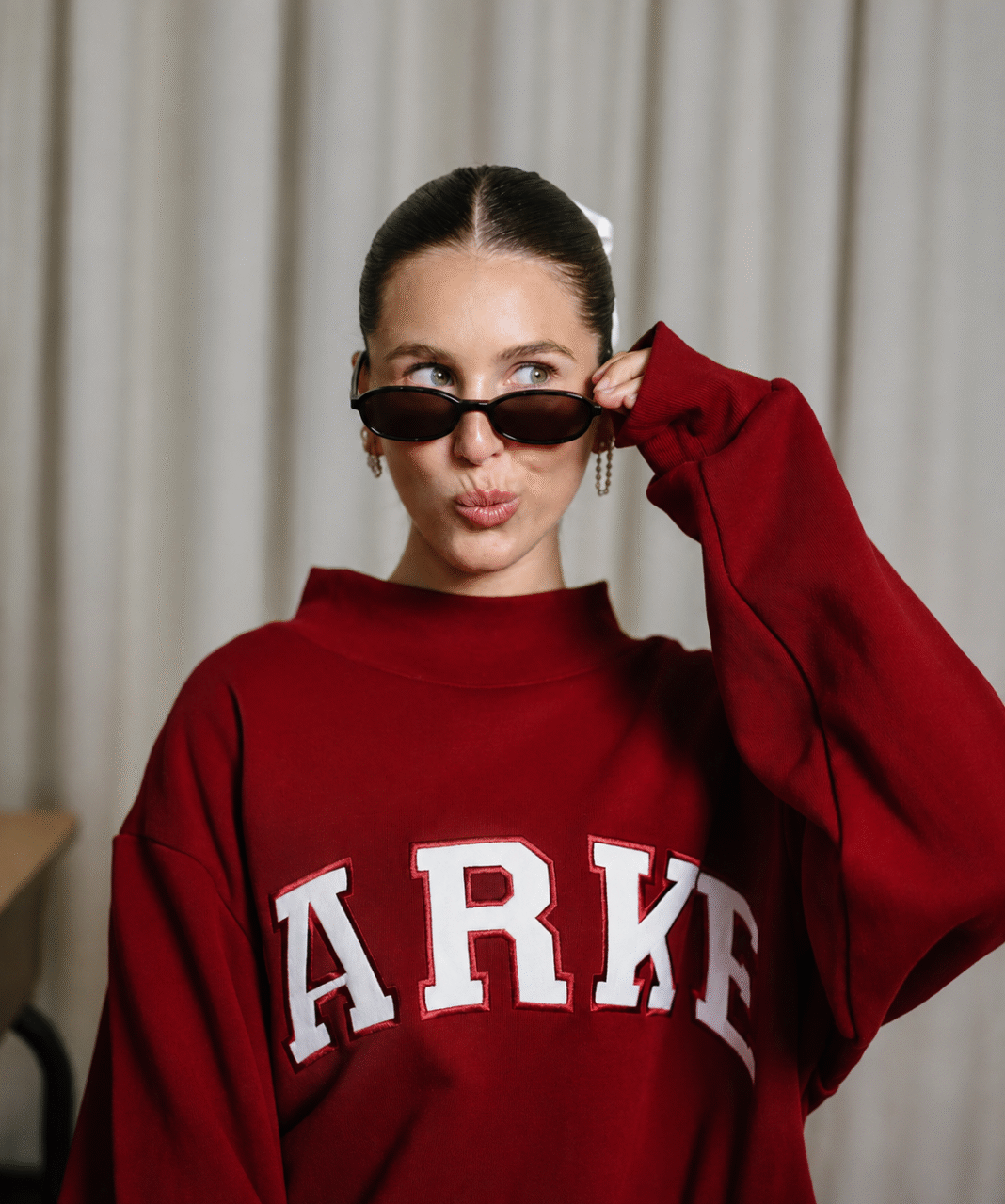
Late one January, a color went to war for the hearts of young women across America. Parke, the New Jersey-bred label known best for crewneck sweatshirts with its own name stitched boldly across the chest, was about to do something it had never done. For its Valentine’s Day drop, it would go purple. The decision was not made in a boardroom or a trend forecast. It was made because Parke’s customers, who had spent the previous spring and summer messaging the brand to ask why it had never offered the shade, said they wanted it. The line sold out fast. And the bond between a company and the people who wear it tightened another notch.
For Chelsea Parke Goles, 29, who grew up in New Vernon and launched her eponymous label in 2022, this is simply how the machine runs. “Our Valentine’s collection included purple only because people told us they wanted it,” she says. “We wouldn’t have done it otherwise.” That single sentence contains the whole philosophy. Parke does not buy traditional advertising. It grows through direct messages, influencer videos, pop-up stores that draw crowds down the block, and monthly product drops engineered to spike desire. You cannot call the company. But you can message its team, and someone will answer, quickly. Engage on Instagram or TikTok and a reply is likely. The intimacy is the strategy.
That strategy has produced numbers that read like a case study, because they now are one. Parke has grown from $100,000 in sales in 2022 to a reported $16 million as of November 2025, and it did it, as Inc. reported this past fall, without spending a single dollar on ads. Goles had already built a following by vlogging her ordinary days, and she watched that highly engaged audience convert, almost seamlessly, into highly engaged customers. Its summer Friday drops have driven order growth of roughly 1,000 percent year over year. “Smaller companies using social media like this have a better grasp of who their audience is,” says Dr. Kevin Lyons, a Rutgers professor who teaches supply chain management for the fashion industry. It is a model larger houses simply cannot fake into existence.
The origin story resists the tidy myth. Goles was not sketching gowns as a girl. “When I was in middle school, I had a uniform for school,” she says. “On weekends, I played sports and rode horses. I didn’t have many clothes beyond school and sports and horses.” She graduated from Morristown Beard School in 2015, studied art at Dickinson, played field hockey, and spent a semester in Florence in 2018 where, she admits, “I spent more time looking at fashion websites than listening to teachers.” The business itself began as a dream shared with Kira Kramer, who was dating her brother Jackson and would later marry him. Over a Loveladies summer spent working jobs they were not obsessed with, the two imagined building something together. “We talked about it as a dream,” Kramer recalls.
The dream arrived first as vintage denim. Working from Miami during the pandemic, Goles noticed the reworked-denim world was not designing for women, and she and Kramer, now COO to Goles’s CEO and creative director, sourced denim from a Los Angeles wholesaler and cut it into women’s jeans. Sizing inconsistencies in the vintage fabric undid them, so in 2022 they pivoted to sweatshirts, which sold immediately, and expanded outward into jeans, overalls, dresses and jackets, warehoused in Middletown, Pennsylvania. The community grew alongside the catalog. “She seems to be very transparent,” says Mae Dolan of Old Tappan, a rising Ohio State senior. “She does Q&As and puts polls up. People type in what they want to see, and she really responds.”
The curation extends to Goles herself. When she married Nicholas Goles in September 2025, fans followed along online, browsing her Dream Registry. When she announced the May birth of her daughter, Willa, the post drew 84,000 likes in a day. That aspirational transparency has begun to attract institutions once out of reach for a four-year-old label. This April, Parke launched its first collaboration with Target, a nearly 60-piece collection spanning ready-to-wear, accessories and the brand’s first-ever swimwear, most items under $40 and starting at $5. “Collaborating with Target is incredibly meaningful to me because it opens the brand up in a whole new way,” Goles told the retailer, framing it as a chance to invite a broader audience into the Parke world.
Goles credits no single trick, only a team of 20 that works, she says, “really hard,” and a birthplace she refuses to leave out of the story. “My Jersey roots have guided me,” she says. “I think a lot of entrepreneurs come from Jersey. It’s a great place.” As the community swells and the drops keep selling out, the plan is less a pivot than a deepening: more engagement, more quality, more of the same conversation that started it. “We like where we are,” she says. So, evidently, do the legions who keep refreshing the page.