
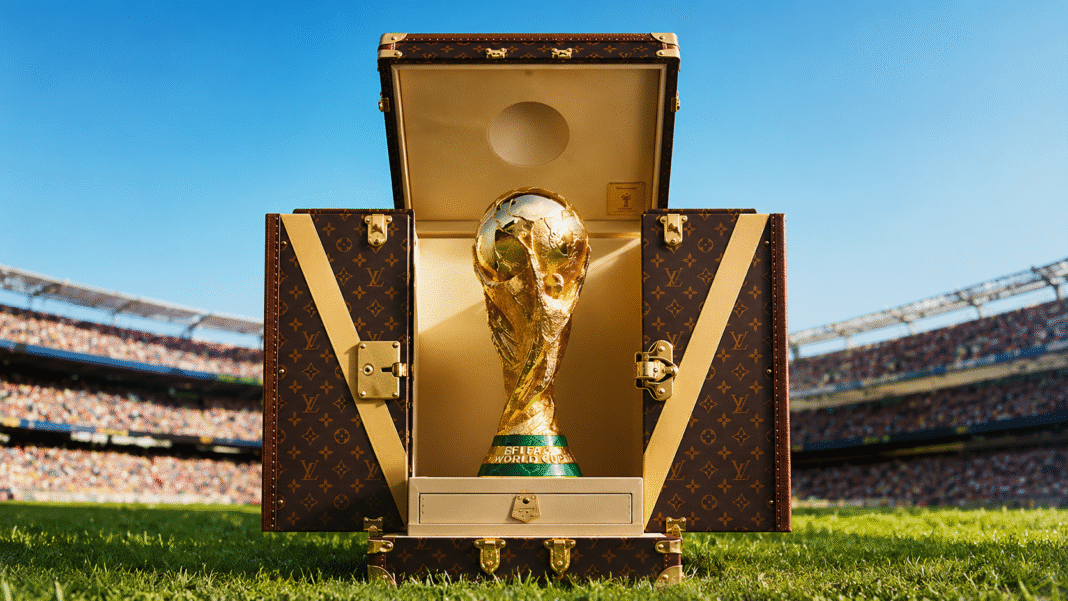
On the night of July 19, inside a floodlit MetLife Stadium in East Rutherford, New Jersey, the most coveted object in world football arrived not in a security case but in something closer to a relic. Louis Vuitton had once again built the vessel: a bespoke Trophy Trunk, wrapped in the house’s unmistakable Monogram canvas, that carried the FIFA World Cup trophy onto the pitch before it was lifted, this time by Spain, in a final watched across every continent. It was the fifth time the Maison has performed this quiet piece of theater, and by now the ritual has hardened into something like protocol, an opening of a case that has become part of the ceremony itself.
The trunk was made where every serious Louis Vuitton trunk has been made since 1859, in the historic Asnières-sur-Seine workshops just outside Paris, a site the founder chose for its proximity to the railway and the Seine, which carried the poplar wood used for trunk frames. That lineage is not incidental to the object; it is the entire argument. The exterior carries a hand-painted golden “V” stretching across two front panels, a letter that stands, with characteristic Vuitton economy, for both “Victory” and “Vuitton.” Leather trim known as lozines runs the edges, while gold-plated brass corner protectors, clasps, and a lock echo hardware the house has used since the 1860s. Inside, the trophy rests in a light beige leather lining shaped precisely around one of the most recognizable forms in sport, finished with a patch marking the collaboration with FIFA.
There is a temptation to read all of this as pure spectacle, luxury attaching itself to the largest audience on earth, and the skepticism is fair. Yet the partnership predates the current era of brand-and-ballpark saturation. Louis Vuitton has supplied the trophy trunk since the 2010 tournament in South Africa, followed by Brazil, Russia, and Qatar, accompanying the prize under the motto “Victory travels in Louis Vuitton.” Pietro Beccari, the house’s chairman and chief executive, framed the continuation in language that treated the trophy as something almost sacred. “At its heart stands the world’s most coveted trophy, a symbol of dedication, collective ambition, and the ultimate celebration of victory,” he said, describing the trunk as an accompaniment to the moment
“when football’s greatest achievement is celebrated and history is made”
The cultural timing sharpens the point. This was the first World Cup final staged in the United States since 1994, complete with a Super Bowl-inspired halftime spectacle, a signal that football’s global grammar is being rewritten for an American audience that treats sport as entertainment on a colossal scale. Into that noise, Louis Vuitton offered something deliberately hushed: an object made slowly, by hand, in a nineteenth-century atelier. The house is betting that heritage still reads as luxury even inside a stadium built for maximalism, and the wager appears sound. The Asnières workshops will open to the public this October during LVMH’s Journées Particulières, and Beccari has already predicted a rush on tickets.
For those who will never lift the trophy, the Maison has extended the fantasy into three limited-edition trunks inspired by the ceremonial design. There is the Coffret 8 Montres, built to hold eight watches, the Cotteville 16 Montres dedicated to horology, and the Malle Courrier Lozine 110, each dressed in Monogram canvas and finished with hand-painted World Cup trophy graphics and the owner’s initials. They are, in the end, the commercial translation of a single idea Louis Vuitton has spent more than a century perfecting, that the way a precious thing travels is itself a form of reverence, and that the container can carry as much meaning as the prize.