
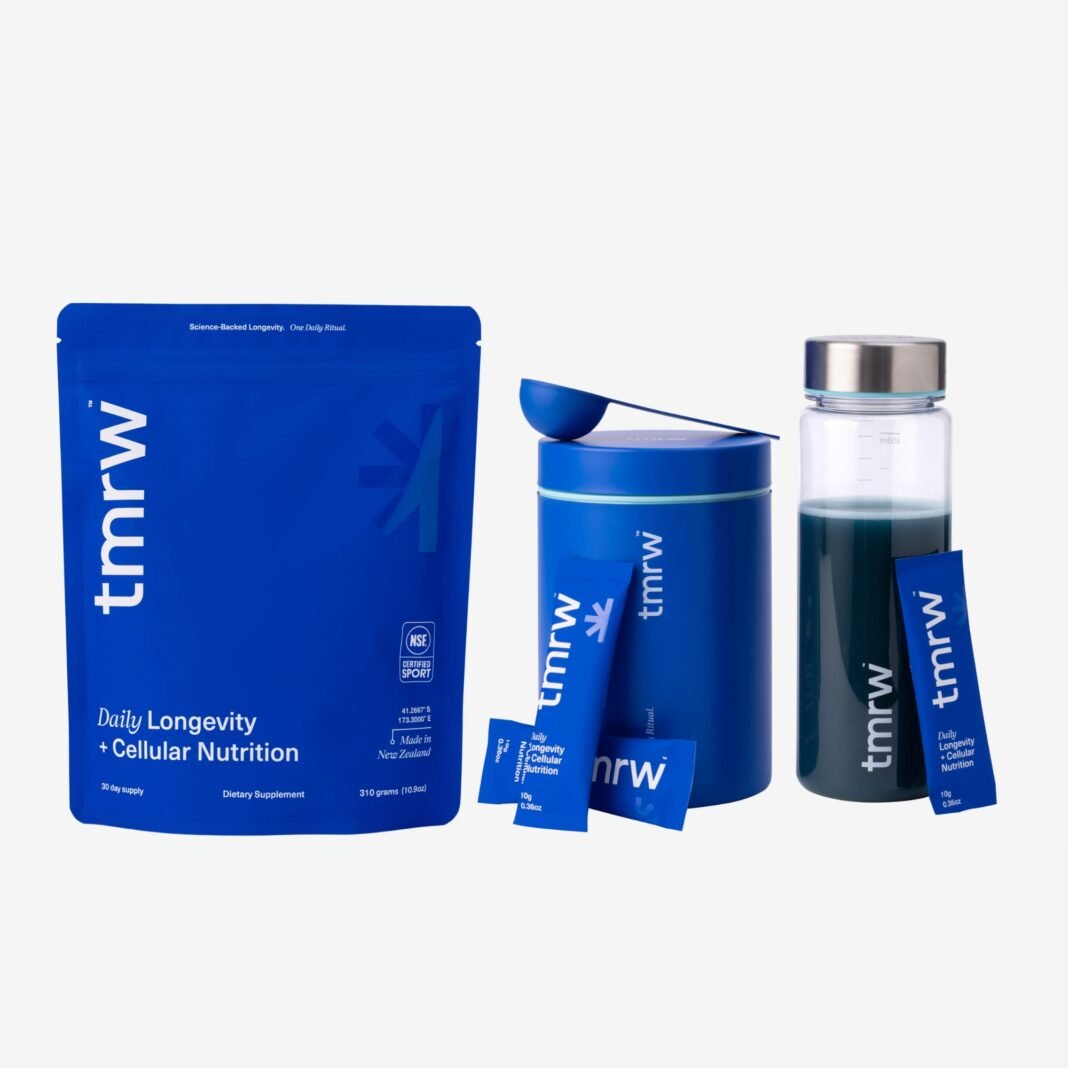
The modern bathroom shelf has become a kind of confession. Ten bottles, maybe more, each one a small promise about energy or focus or the slow arithmetic of aging, lined up like a to-do list no one can quite finish. On September 24, a brand called Tmrw arrived in the United States with a provocation aimed directly at that shelf: a single blue scoop, eighty-eight ingredients deep, designed to make the rest of the lineup redundant. After more than two years of development and over one hundred formulation iterations, the all-in-one daily longevity drink is positioning itself not as another product to add, but as the one meant to clear the counter entirely.
Tmrw is the work of Anthony Baxter and Stuart Vaughan, the entrepreneurs behind Simply Nootropics, and its origin story is as much about exhaustion as ambition. Baxter has spoken openly about a period of severe burnout while running a digital agency, a reckoning that pushed him toward his own health and, eventually, toward the realization that wellness had become its own form of overwhelm. He and Vaughan had spent years watching customers assemble increasingly elaborate routines, one powder for gut health, another for cognition, a third for energy, a fourth for longevity. “People shouldn’t need a medicine cabinet full of supplements to take their health seriously,” Baxter says. The goal, he explains, was to bring those systems together “without cutting corners on the ingredients, dosages or quality standards that actually matter.”
What separates Tmrw from the crowded shelf of greens and reds powders is its willingness to disclose exactly what is inside and in what amount. The formula carries clinically relevant doses of longevity actives that most blends only gesture toward: 500mg of NMN, 1,000mg of CaAKG, 1,200mg of taurine, and 100mg of Ubiquinol CoQ10, alongside a ten-strain probiotic blend, prebiotics, digestive enzymes, activated B vitamins, and an adaptogen and nootropic complex. Baxter’s own account of the build adds spermidine, urolithin A, and fisetin to the roster, compounds that have become shorthand for the cellular-aging conversation. It is a transparency play in a category that has long relied on proprietary blends and the vague reassurance of a long ingredient list.
The aesthetic tells its own story. Tmrw’s signature blue was drawn from the Blue Zones, the handful of global regions, Okinawa, Sardinia, Ikaria among them, where people routinely live past one hundred. It is a smart bit of visual shorthand, locating a lab-built supplement inside a far older and more romantic idea of longevity as something cultural, communal, and lived rather than merely dosed.
Tmrw enters a moment of genuine fervor around healthspan. The brand arrives alongside well-funded competitors like Bryan Johnson’s Blueprint Longevity Mix, part of the tech founder’s multimillion-dollar anti-aging regimen, and the category has tipped from biohacker curiosity into mainstream wellness ritual. Credibility, in this environment, is the real currency. Tmrw launched with NSF Certified for Sport status, one of the industry’s most stringent third-party programs, which verifies label accuracy and screens for banned substances. Every batch is third-party tested and manufactured in New Zealand to pharmaceutical-grade GMP standards, with many ingredients sourced from local suppliers and farms.
Guiding the formulation is a science advisory board led by Brian Ramos, PhD, a Yale-trained neurobiologist who serves as head of research and development, joined by circadian-health researcher Kristen Holmes, PhD, metabolic-health physician Dr. Clay Moss, MD, and performance specialist Dan Giordano, PT, DPT. “Tmrw just has the ‘it’ factor,” Ramos says, crediting a formulation ambition that was balanced, in his words, “against true care of the customer’s needs and building whole health from within.”
The commercial case is already building. Tmrw entered its official launch with more than 35,000 orders and one million servings consumed, serving customers across 57 countries with the United States as its largest market. Tmrw Daily sells for $119 as a one-time purchase or $89 on a four-week subscription, a premium that reflects the consolidation it promises. The brand says observational studies and further clinical research on its core formula are planned. Whether one scoop can truly replace twenty bottles remains, for now, a question the market will answer. But the pitch lands at exactly the right cultural moment: not another thing to take, but permission to take less.