
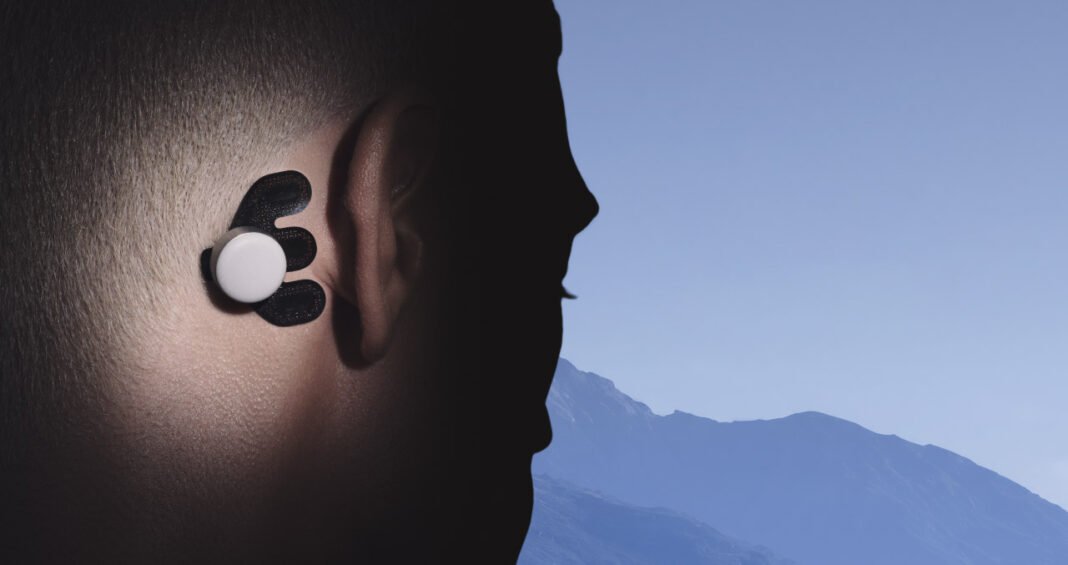
For years, the wearables on our wrists and fingers have told us a story about the body: how we slept, how hard our hearts worked, how many steps we logged before noon. Atlas, a San Francisco startup founded in 2021 by neuroscientists Ana Montero and André Marques-Smith, wants to tell a different story, one sourced not from the periphery but from the organ that actually generates focus, stress, and fatigue. On September 1, the company opened preorders for the Atlas 1.0, a $499 behind-the-ear device that promises to bring research-grade brain tracking out of the sleep lab and into an ordinary Tuesday. The ambition is enormous. The evidence, so far, is still arriving.
The device itself is a small rechargeable puck, black or white, that adheres to the hairless skin behind the ear on a thin adhesive pad. Inside sits a four-sensor stack: EEG to read electrical brain activity, an inertial sensor for head motion, skin-conductance sensing, and a channel that detects the vibrations of speech without recording the words themselves. From those inputs, Atlas generates three daily metrics it calls Presence, Stress, and Energy Burn, then connects them to the texture of your life, your sleep, your workouts, your calendar, the people and places that fill your hours. The premise is that a number rising around a 4 p.m. meeting or falling after a morning run might reveal a pattern worth examining.
What makes the Atlas 1.0 genuinely novel is where it claims to work: in motion. Most consumer brain devices confine themselves to stillness, to meditation or sleep or the quiet of a desk. Atlas says it has solved the engineering problem of capturing usable EEG while a person walks, talks, drives, and lives, and that it trained its algorithms on more than 500,000 real-life recordings, which it describes as the largest dataset of its kind. “That commitment to accuracy makes Atlas a tool for genuine mastery and personal science, not just measurement and vanity metrics,” Marques-Smith, the company’s chief technology officer, has said. It is a compelling pitch. It is also, for now, a company claim. Atlas has not linked a peer-reviewed paper or public validation dataset in its launch materials, which leaves the central question open: how accurately do three tidy scores describe the messy reality of a human mind across a real day?
That question matters because the science of compact EEG is real but qualified. A 2024 study of a different in-ear device, the IDUN Guardian, found it could classify two levels of cognitive workload at 68.4 percent accuracy, compared with 92.9 percent for conventional lab EEG. The result is encouraging and sobering at once: convenient brain sensing is possible, but the tradeoffs are meaningful, and none of it establishes what the Atlas can do. To its credit, Atlas hedges in its own FAQ, describing its scores as interpretations rather than verdicts and cautioning that a higher number is not universally better. The consumer algorithms are also limited to daytime use, a detail worth holding onto given the all-day framing.
The timing is culturally sharp. Oura, the ring that helped normalize sleep scores, currently faces a proposed class action arguing that finger-based signals can only poorly infer what the brain is doing, an accusation that quietly makes Atlas’s case for more direct measurement even as it underscores how fragile consumer trust in these numbers can be. Atlas has raised $24 million from investors including Acrew Capital and Compound, and was selected for the NBA’s Launchpad program. Yet the commitment it asks of buyers is steep: $499 up front, then $29.99 a month for sensors, app access, and insights, with deliveries not expected until the first quarter of 2027. As of early September, the Pioneer Edition already reads “Sold out.”
For André Marques-Smith, the launch was six years removed from what he described as “pizzas in Kensington with my best friend/co-founder Ana Montero,” a company grown from two people to thirty-five across four continents. That human origin is easy to root for. Whether the Atlas 1.0 can consistently turn brain waves into insight you can actually act on, and whether acting on it makes your days better, remains the honest, unresolved heart of the story.