
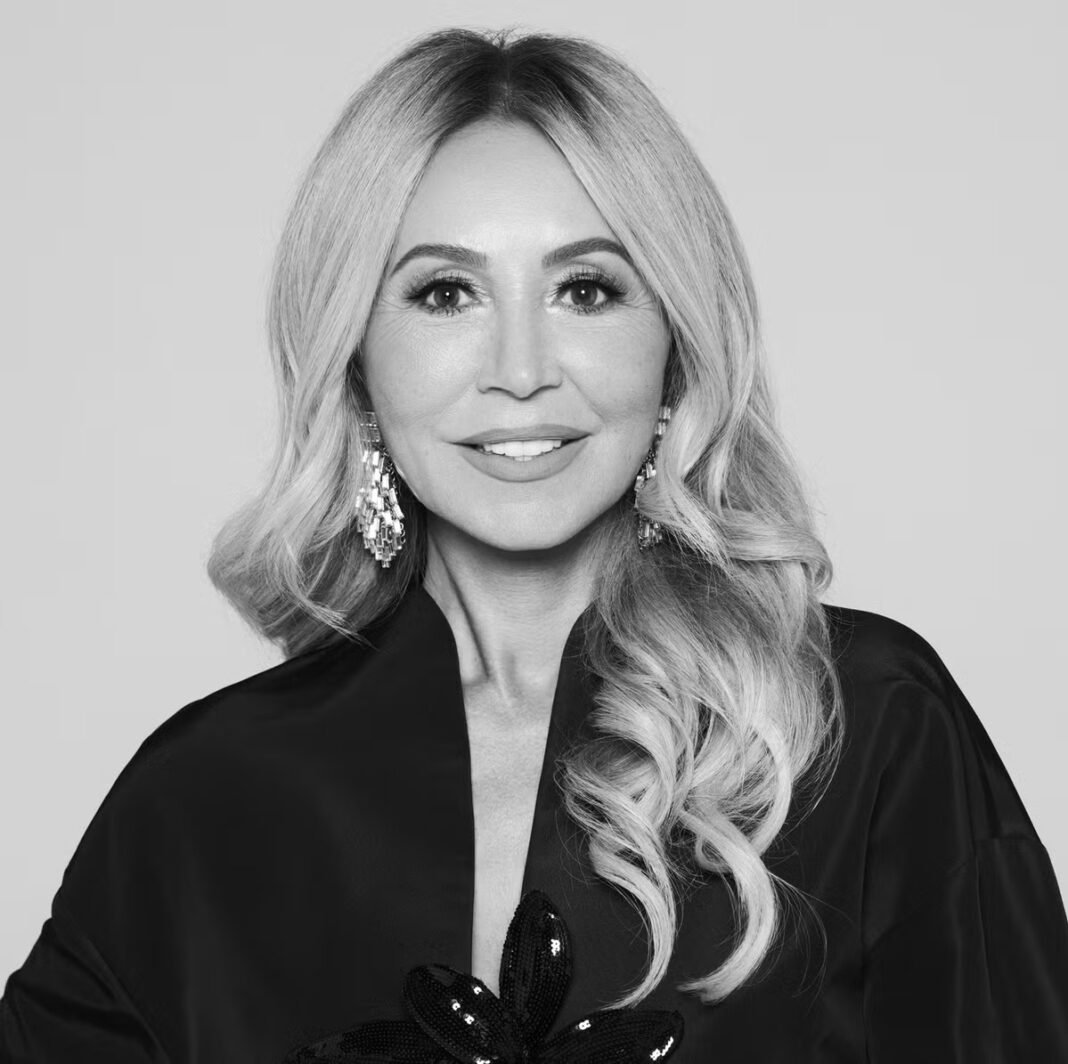
She was twelve years old, doing homework between the sewing machines in her mother’s atelier in Constanța, when Anastasia Soare first learned to read a body the way a sculptor reads marble. Her mother, a tailor in communist Romania, never knew the phrase “Golden Ratio,” but she understood its logic intuitively: smaller shoulders and fuller hips called for balance, a shoulder pad here, a nipped seam there, so the garment answered the woman rather than fought her. That early apprenticeship in proportion, absorbed long before Soare could name it, would eventually become the foundation of a beauty empire and the through line of her new memoir, Raising Brows: My Story of Building a Billion-Dollar Beauty Empire, a national bestseller she recently celebrated with a one-night-only conversation moderated by Oprah Winfrey at the Wilshire Ebell Theatre in Los Angeles.
The arc from that theater stage back to those sewing machines is improbable enough to feel scripted. Soare arrived in the United States in the late 1980s speaking no English, and found work as an aesthetician in a boutique where her very first client was Cindy Crawford. Word traveled, as it does in a business built on proximity and trust, and soon her reputation for shaping brows according to mathematical harmony reached a wider audience. Appearances on The Oprah Winfrey Show followed, including the now-legendary 1998 segment where she debuted her Golden Ratio method to a global audience, and the woman who had once studied Oprah’s program to learn English found herself shaping Oprah’s eyebrows on the very same show. She patented the technique. At its 2018 peak, the brand she built from a single rented salon room was valued at roughly three billion dollars.
What makes Soare compelling is not the scale of the success but the psychology beneath it, a fearlessness she traces directly to the country she left. “I was never ashamed. I was never afraid to say, I don’t know. Can you help me with this?” she says. Growing up somewhere a person could be jailed or worse for no reason at all, she explains, drains fear of its power. “You become numb. You don’t have fear anymore. You have sadness, maybe. But I wasn’t afraid of anything.” When she decided, after only a year and a half in America, to open her own business in a small room inside a salon, everyone told her she was crazy. Her answer was disarmingly simple. She had no status to protect and therefore nothing to lose.
That absence of ego became a strategy. Soare built her early business on what psychologists call the Benjamin Franklin effect, the counterintuitive truth that people tend to like you more after they have done you a favor. She asked her clients for help constantly, unbothered by the possibility of no. “People should not have a fear of being rejected,” she says. “You can go to somebody else.” The favors she once requested she now returns compulsively, taking evident joy in connecting one person to another, and she is candid that the road included expensive lessons. A preservative-free shea butter body line, ahead of its time in its sustainability, spoiled on shelves and lost money. A Nordstrom launch taught her that stocking a product and selling one are entirely different disciplines. Each failure, she insists, was tuition.
Her relationship to exhaustion is bracingly out of step with the current wellness conversation, and she offers it without judgment. Coming from a place where she could not hold a single job, the American permission to hold three struck her as pure luck. “When you start telling your brain that you are tired, you really believe that you are tired,” she says. She watched her mother work this way, and she watches her daughter, Claudia Soare, known as Norvina, do the same now. Anxiety, too, she regards as a problem to be solved rather than a state to be endured. She lives in the present, she says, because the past cannot be changed and worry solves nothing.
There is one more thread, tender and unexpected, running through her Romanian origins. Soare is the godmother of actor Sebastian Stan, born in the same town, the son of a friend she has known since the fifth grade. Stan attended her memoir launch and spoke movingly about the confidence she gave him as a self-conscious teenager. “He’s an amazing person, and such a talent,” she says. “I love him.” It is a fitting coda for a woman whose entire career has been about helping people see themselves more clearly, one carefully measured line at a time.