
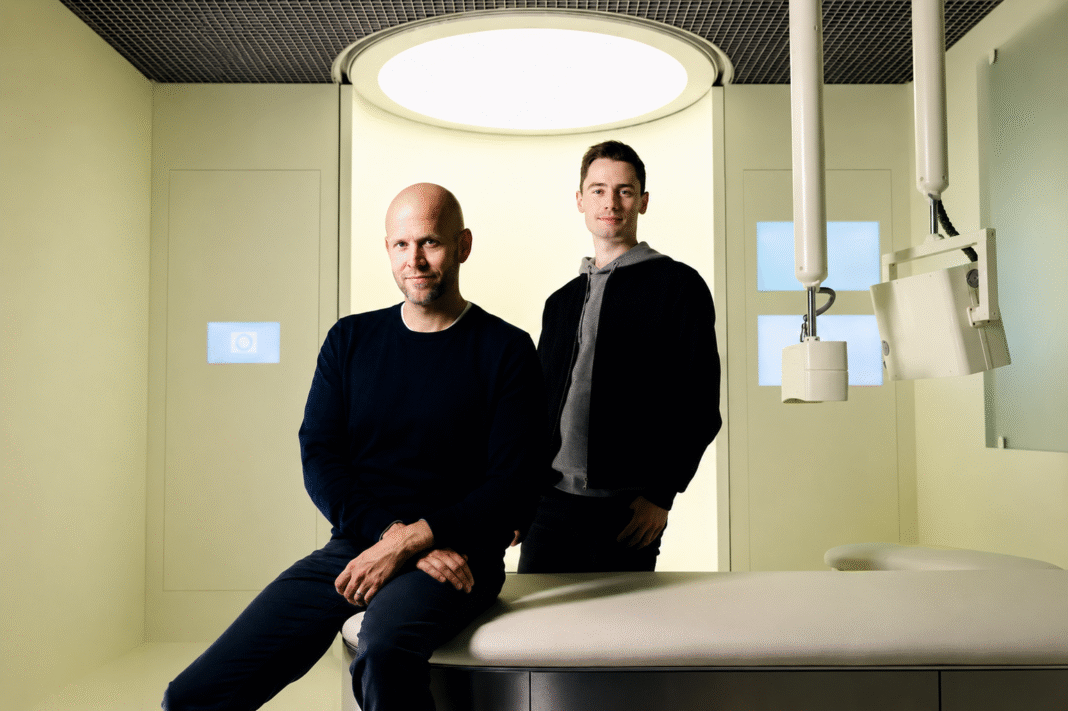
On September 24, a Swedish idea about the future of your body arrives at 300 Lafayette Street, in the SoHo blocks better known for flagship boutiques than for bloodwork. This is where Neko Health, the body-scanning company co-founded by Spotify’s Daniel Ek and chief executive Hjalmar Nilsonne, will open its first American clinic, and the appetite has already outpaced the doors. More than 25,000 New Yorkers have added their names to a waitlist for a service that promises something the American healthcare system rarely delivers on schedule: the sense of getting ahead of what might go wrong before it does.
The proposition is precise. For $499, a visit centers on the Neko Body Scan, a roughly 60-minute, non-invasive, radiation-free assessment that the company says captures millions of data points, paired with bloodwork that returns results within the same appointment and cross-referenced against data from a person’s own fitness devices. The scan is built to screen for early markers of the conditions that quietly accumulate, skin cancer, heart disease, prediabetes, and it is designed to hand a reading of your interior life back to you in near real time. What Neko is selling is not only the machinery but the conversation that follows it.
That distinction matters, and the company knows it. Following the scans, patients spend roughly 20 to 25 minutes reviewing the findings with a clinician, and Neko has made a near-slogan of the ratio. “You spend more time in the room with the clinician than you do in the room with the tech,” the company has said, a line that reads as a quiet rebuke of a system in which the average patient often gets neither. It is a reframing of prevention as an experience rather than an errand, and it is why the SoHo address, all luxury adjacency and intentional design, is not incidental.
Neko arrives in New York on a considerable updraft. The company already operates six locations across the United Kingdom and Sweden, has delivered scans to more than 100,000 people, and counts over 300,000 registered or waiting worldwide. In July, it raised a $700 million Series C co-led by Lightspeed Venture Partners, a round that valued the company at nearly $7 billion, roughly four times its worth a year earlier, and drew a startling roster of backers including Mark Zuckerberg, Maria Sharapova, and will.i.am. Ek has framed the demand as almost cultural. He told the New York Times that the company had entered markets where healthcare is free and still watched hundreds of thousands of people line up to pay, a phenomenon he said “captures the imagination.” Neko says three in four returning members whose scans flagged a serious condition now have it under control.
The company’s timing places it inside a much larger movement, one where longevity has become both a wellness aspiration and a venture thesis. Neko is not alone in the scramble. Midjourney, the AI image lab, is developing a body scanner intended for a spa experience it plans to open in San Francisco in 2027. Tony Robbins and Peter Diamandis run a longevity venture called Fountain Life, and Function Health, co-founded by the wellness podcaster Dr. Mark Hyman, added body scans after acquiring the startup Ezra, then took on a $450 million loan structured around profit-sharing. Established US rivals Prenuvo and Ezra already sell whole-body MRI scans to the same worried, well, and willing clientele.
What separates Neko, at least in its own telling, is that it owns the entire stack, designing its hardware, software, and clinics in-house so it can iterate faster than competitors tethered to off-the-shelf machines. Whether a 60-minute scan can meaningfully rewrite anyone’s health outcomes remains a longer question than a single appointment can answer, and the medical value of screening the well is genuinely debated. But the cultural signal is already legible. A generation raised on tracked sleep and quantified workouts is arriving in SoHo ready to pay for a portrait of the body it cannot otherwise see, and Neko is betting that once you have looked, you will want to look again.