
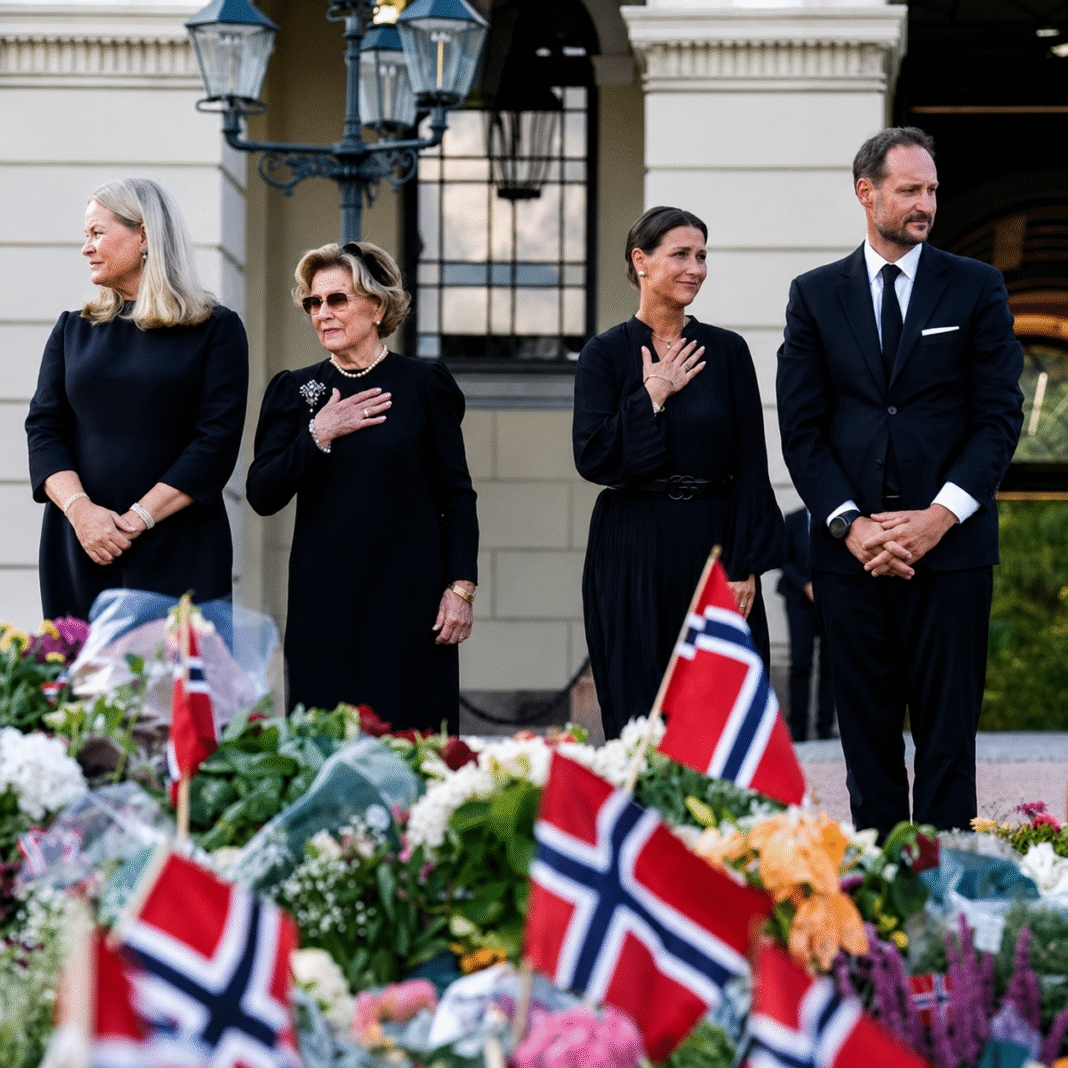
On Monday afternoon in Oslo, four members of Norway’s royal family walked out from behind the palace walls and into a sea of grief that had been gathering at their doorstep for days. King Haakon, Queen Mette-Marit, Queen Sonja, and Princess Märtha Louise each carried a single rose, and one by one they laid them among the thousands of flowers already blanketing Palace Square, the informal memorial that has swelled since King Harald V died on the morning of Friday, August 28, at the age of 89. It was a small gesture in the face of an enormous loss, and it was also, quietly, a beginning: the first time Haakon and Mette-Marit had met the public as King and Queen.
Europe’s oldest reigning monarch, Harald had ruled for 35 years, and the affection Norwegians felt for him has poured into the square in the most personal forms imaginable. Candles, handwritten letters, photographs, and objects carried from homes across the country have accumulated into a sprawling landscape of remembrance. The royals did not rush through it. They stopped to read the notes strangers had written, bent to look closely at the photographs, and lingered over the items people had chosen to leave behind. Then they did something that dissolved whatever distance remains between a monarchy and its people: they joined the crowd in singing the Norwegian national anthem before returning inside to a wall of applause.
The grief on display is not abstract. For many Norwegians, Harald was a figure of unusual intimacy, a king who reigned by consent rather than command and who seemed to understand that the throne’s authority in a modern democracy rests entirely on being loved. “I personally will say he was everything for us, especially being an immigrant,” Biteya Terfassa, an Oslo resident born in Ethiopia, told Reuters. “He made us feel at home, and he made us feel loved. So he was like a grandfather that I never had.” It is a sentiment that echoes the words Harald himself made famous in a 2016 palace garden speech, when he declared that Norwegians are “girls who love girls, boys who love boys, and girls and boys who love each other,” a moment of quiet radicalism that recast the monarchy as a symbol of belonging.
Queen Sonja, his wife of 57 years, appeared visibly moved by the applause. She was the last to reenter the palace, escorted by her daughter, Princess Märtha Louise, a small tableau of a widow supported by her child that needed no explanation. Prime Minister Jonas Gahr Støre captured the national mood plainly, saying that the country was united in grief and gratitude, a phrasing that has become something of a refrain across Norwegian media in the days since.
The appearance came hours after the bier ceremony, during which Harald’s coffin, draped in the royal standard, was carried in solemn procession through the palace’s formal rooms before being brought to the Palace Chapel. His children and grandchildren bore the weight of it themselves. Beginning Tuesday, members of the public will be able to enter the chapel to pay their respects, and it will remain open daily through Tuesday, September 8. The following day, September 9, Norway will gather at Oslo Cathedral for the state funeral of the boy who once fled Hitler’s invasion to shelter in the White House and grew into the king who modernized his country’s crown. His son now reigns as King Haakon VIII, and his granddaughter, Princess Ingrid Alexandra, becomes heir to the throne, the line moving forward even as a nation stands still.