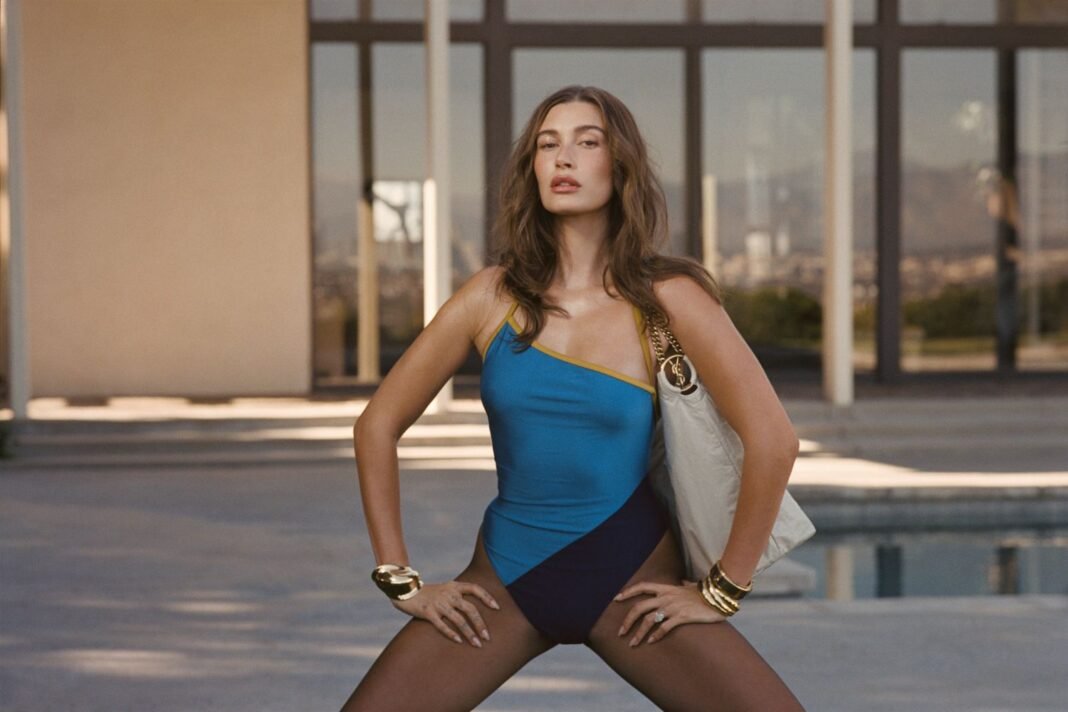
There is a specific kind of image that only arrives when the right photographer meets the right subject at exactly the right cultural moment. Saint Laurent‘s Spring 2026 campaign, titled “Tangerine Temptation,” is that image, repeated across a series of sun-drenched frames that feel simultaneously impossible and inevitable. Shot by Nadia Lee Cohen against the backdrop of an iconic mid-century residence in the hills above Los Angeles, the campaign announces itself not as a seasonal lookbook but as a fully realized piece of cinema, and it does so without apology.
Anthony Vaccarello has long understood that the Saint Laurent woman requires a world worthy of her. For this chapter, he found it in Cohen, the British-born photographer and director whose work has been described as “character-driven visions of saturated and surreal dreamscapes,” a phrase that reads less like a biography and more like a blueprint for everything “Tangerine Temptation” accomplishes. Cohen has previously directed campaigns for Balenciaga and YSL, worked with Beyoncé and A$AP Rocky, and earned Cannes Golden Lions recognition for her film work. She arrives at this commission not as a hired lens but as a co-architect of a visual language Vaccarello was clearly ready to speak.
Leading the campaign is Hailey Bieber, a figure who has spent the better part of two years quietly consolidating her position as one of fashion’s most trusted collaborators. Fresh from her rhode beauty activation at Coachella, where she turned the festival circuit into a brand moment, Bieber brings to Saint Laurent something rarer than beauty: the ability to inhabit a mood rather than merely pose within it. Alongside her, models Lina Zhang and Jake Hodder complete the campaign’s tightly wound trio, the three of them drifting through architectural interiors and sun-scorched terraces with the ease of people who have always lived inside a Nadia Lee Cohen photograph.
The clothes reward the attention. Bieber moves through four distinct Saint Laurent looks, among them a color-blocked one-piece swimsuit trimmed in mustard yellow, its diagonal seam drawing the eye with the precision of a technical drawing, and a leather trench coat that reframes the house’s signature tailoring as something closer to armor. Throughout, the Spring/Summer 2026 collection plays the tensions Vaccarello has made his signature: sharp structure against fluid movement, control pressed against sensuality, the austere against the electric. All of it is suffused in that citrusy, warm-register glow that gives the campaign its name and acts as its unifying visual thread.
Set to Beethoven’s Symphony No. 7, the campaign’s film component layers this citrus palette over a distinctly 1970s bourgeois sensibility, figures floating in pools, pausing in foyers, moving across terraces as if time has agreed to slow down for them. Cohen’s high-gloss surrealism, born in the trashy stores and broken dreams of the real Hollywood Boulevard and refined into something entirely her own, is here made to serve the house rather than subvert it. The result is one of the most coherent campaign visions Saint Laurent has produced in years.
Under Vaccarello, the Saint Laurent woman has never been a type. She has been a position, a way of occupying space that the clothes make possible but do not define. “Tangerine Temptation” does not argue against that legacy. It simply turns up the wattage.