The most radical thing happening at Coachella 2026 is not on any stage. It lives somewhere between stages, in the wide, sun-bleached stretches of the Empire Polo Club where the bass from one set dissolves into the approaching wall of another, and where, this year, three large-scale installations have quietly staked a different kind of claim on the grounds. Through both festival weekends, Public Art Company returns as Coachella’s art curator, and its 2026 program arrives as something genuinely worth pausing for.


PAC founder Raffi Lehrer and Goldenvoice art director Paul Clemente curated the outdoor suite with an explicit philosophy. “What unites them is a shared generosity,” Lehrer said. “Each piece is designed to be entered, sat beneath, wandered through, and genuinely felt. We’re curating for the body as much as the eye.” That mandate shows. Where past editions have produced visual landmarks, this year’s selection is more interested in shelter, containment, and slow looking, a rare counteroffer at a festival built almost entirely on momentum.
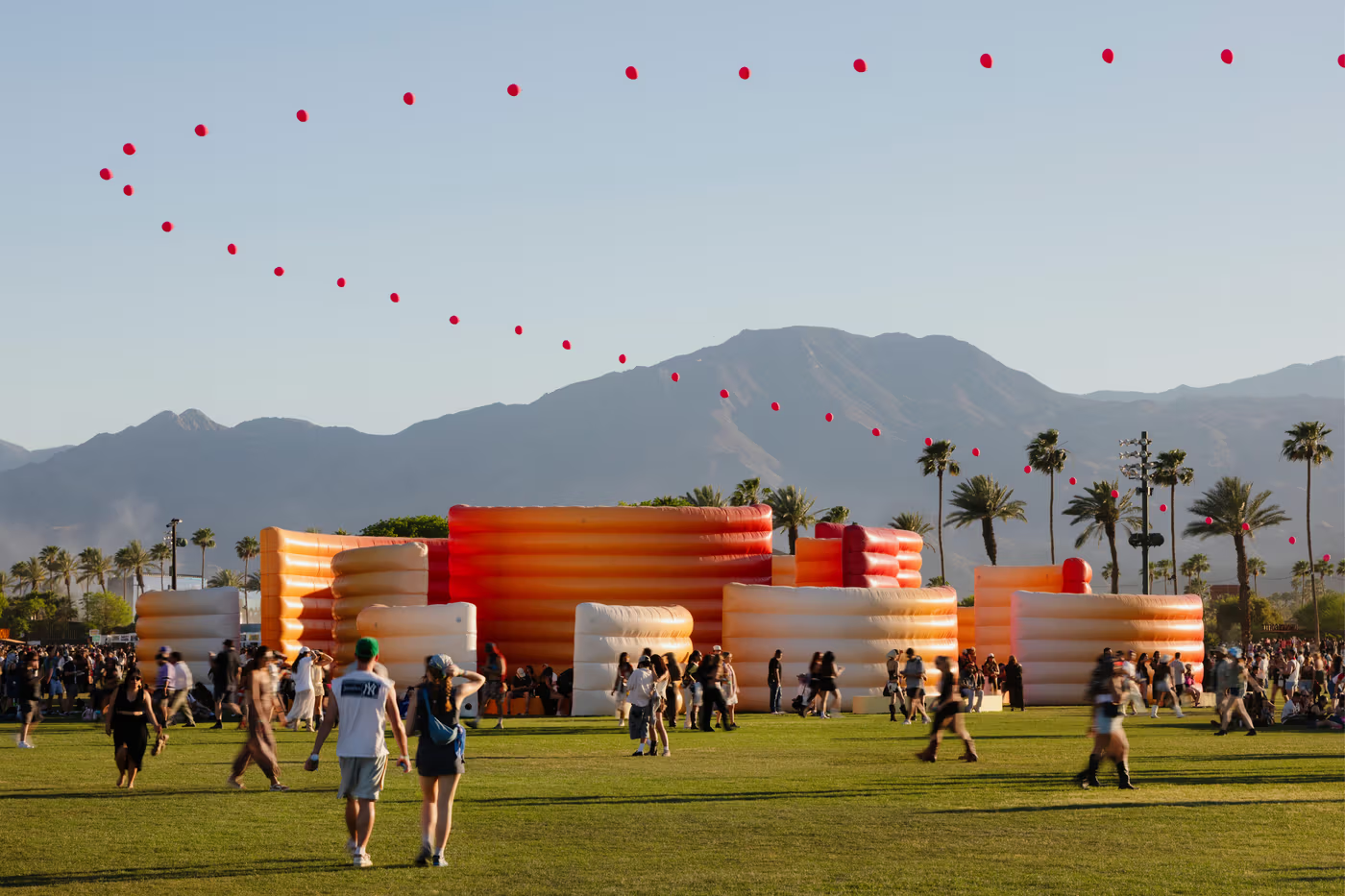
Headlining the program is “Maze,” a winding inflatable structure by Rotterdam-based designer Sabine Marcelis. Known for her refined investigations into light as material, Marcelis spent time in the high desert region as a teenager and returned to that formative geography as her conceptual anchor. The piece is constructed from stacked PVC arcs in a gradient that runs from pale cream through tangerine to a deep, bodily red at its core. “I wanted to bring the movement of the mountain ranges and create a setting that felt very isolated from its surroundings,” Marcelis told Wallpaper. “I wanted to create the feeling of being surrounded the same way the Coachella Valley is surrounded by the mountain ranges.” The result is a structure that functions less as sculpture than as terrain, filtering sound and Indio sunlight during the day, then glowing from within after dusk like a molten topography against the open sky. The project took roughly a year to develop, moving from early site visits to full-scale on-site production.


London-based architect Kyriakos Chatziparaskevas takes a different cue from the landscape. “Starry Eyes” is a cluster of near-40-foot pleated forms inspired by the barrel cactus, a plant native to the region. Visitors can step into the base of each structure, where star-shaped skylights overhead frame the blue above and swells of color function as shaded rest stops. By night, those interior spaces transform into illuminated lanterns, the fabric skins glowing with an internal light that turns the installation into a field of outsized warmth.
The third work, “Visage Brut,” comes from the Los Angeles Design Group, led by Andrew Holder and Claus Benjamin Freyinger, working in collaboration with computational construction group Stud-IO. A lofty tower of modular steel forms, each box described by the architects as “just short of losing its structural integrity,” it builds on LADG’s long inquiry into urban history and formal language. The forms are cut, warped, folded, and rolled, and as the day shifts toward dusk, the dense sculptural mass gradually opens into a filigree lattice, changing character with the light.


What PAC has assembled at Coachella 2026 is a program that knows where it is and what the body needs there. These are not monuments for the camera. They are spaces for the interval, for the breath between songs, for the moment when a festival of this scale briefly becomes something quieter and stranger than itself.