
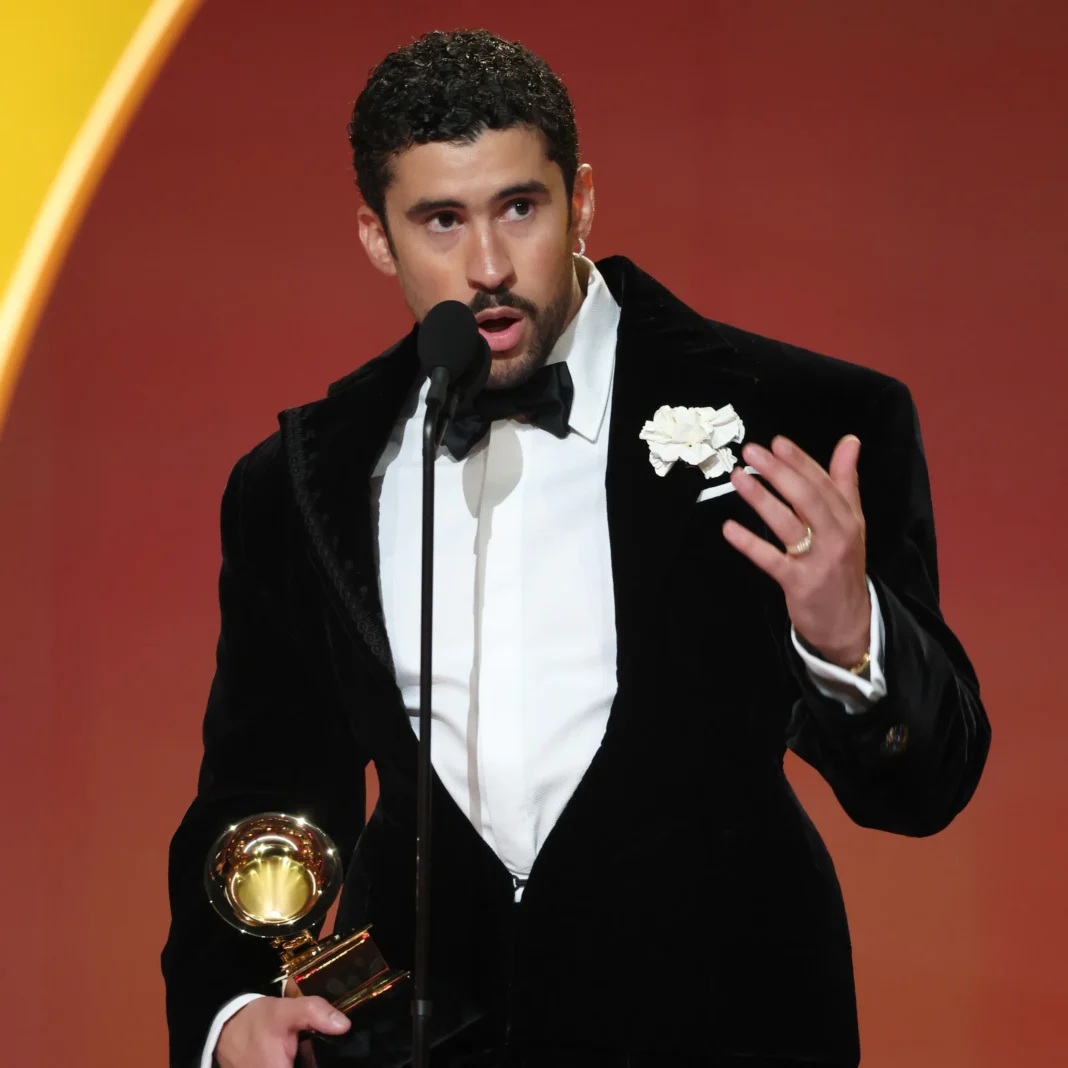
When Bad Bunny buried his head in his hands at the 2026 Grammys, overcome after hearing his name called for Album of the Year, the pause wasn’t just emotion—it was the weight of history. “Debí Tirar Más Fotos“ became the first Spanish-language album to claim the Recording Academy’s flagship prize in the ceremony’s 68-year existence. Not Buena Vista Social Club. Not any of Shakira’s crossover juggernauts. Not even the genre-demolishing work of artists who’ve dominated global streaming for years. The breakthrough raises an uncomfortable question: if Bad Bunny’s album—a commercial powerhouse that celebrates Puerto Rican resilience while topping charts worldwide—is finally “worthy” of the Grammy’s top honor, what does that say about the decades of Latin music excellence the Academy overlooked? As Bad Bunny prepares to headline next week’s Super Bowl, his Grammy victory illuminates not just his singular achievement, but the institution’s blind spots that kept this ceiling intact for so long.
The timing of this historic win is revelatory. Latin music has not been waiting in the wings for recognition. It has been the dominant force in global music consumption for years. Streaming platforms have consistently shown Spanish-language tracks outperforming English-language counterparts in international markets. Bad Bunny himself has been Spotify’s most-streamed artist globally for multiple consecutive years, a metric that directly reflects listener engagement and cultural impact. Yet until Sunday night, the Recording Academy’s most prestigious award remained inaccessible to music performed primarily in Spanish.
This disconnect reveals a fundamental tension within the Grammy voting structure. The Recording Academy operates on a membership model where voting power is distributed among music professionals, many of whom built their careers during eras when the American music industry remained largely English-centric. The institutional inertia within this system has consistently favored familiar sonic landscapes over the recognition of artistic excellence that challenges linguistic comfort zones. The demographic composition of Grammy voters has been slow to reflect the actual diversity of music consumption patterns, creating a lag between what audiences celebrate and what the Academy validates.
The economic evidence of this marginalization is particularly stark. Latin music generated billions in revenue for the recording industry throughout the decades when Grammy recognition remained elusive. Major labels built entire profit centers around Latin divisions, capitalizing on the commercial viability of Spanish-language music while the industry’s most visible awards platform continued to overlook it. This created a paradox where record executives profited handsomely from Latin artists while those same artists remained systematically excluded from the industry’s highest honors. The financial contradiction exposes the awards not as meritocratic measures of artistic achievement, but as reflections of institutional gatekeeping that operates independently from market success or cultural relevance.
Bad Bunny’s acceptance speech, delivered mostly in Spanish and punctuated with the pointed declaration “ICE out,” reframes the win as more than personal achievement. This move signals a refusal to perform gratitude within the confines of institutional expectations. By centering his Puerto Rican identity and making an explicit political statement about immigration enforcement, Bad Bunny transformed what could have been a moment of institutional validation into a platform for challenging the very systems that delayed this recognition. The speech acknowledges the award while simultaneously refusing to sanitize his identity or politics for mainstream comfort.
The breakthrough also raises questions about what systemic changes within the Recording Academy finally enabled this outcome. In recent years, the organization has undertaken membership expansion efforts explicitly designed to diversify its voting base. These reforms followed years of criticism about the Grammy’s failure to recognize hip-hop, R&B, and non-English language music with the same frequency as rock and pop categories dominated by white artists. The addition of younger voters and international members has gradually shifted the composition of the electorate, suggesting that Bad Bunny’s win may represent the fruits of structural reform rather than a sudden change of heart among existing gatekeepers.
Yet even this progress demands scrutiny. The fact that institutional change was necessary for Latin music to receive top honors—despite its commercial dominance and artistic merit—underscores how deeply bias was embedded in the Grammy evaluation process. The music itself did not change. Bad Bunny’s work is not objectively more deserving than the Spanish-language albums that preceded it. What changed was the composition of who gets to decide what constitutes excellence, revealing that the previous barriers were never about the music’s quality but about who held decision-making power.
The significance of this moment extends beyond Bad Bunny individually. His win creates a precedent that may lower barriers for future Spanish-language artists, demonstrating to voters that non-English music can occupy the category’s highest tier. This is particularly important for younger and emerging Latin artists who now have concrete evidence that the industry’s most prestigious platform is not permanently closed to them. The psychological impact of seeing someone who sounds like them, who refuses to code-switch or assimilate linguistically, claim the top prize cannot be overstated.
The timing of this Grammy victory, arriving just one week before Bad Bunny headlines the Super Bowl halftime show, creates a cultural resonance that amplifies both platforms. This trajectory mirrors Kendrick Lamar’s path the previous year, suggesting an emerging pattern where Grammy success and Super Bowl visibility now function as mutually reinforcing cultural validators. For Bad Bunny, this sequence positions him not as a genre artist receiving niche recognition, but as a mainstream cultural force whose influence spans the industry’s most visible stages. The Super Bowl platform, watched by over 100 million viewers, will now be occupied by an artist whose Grammy win validates his place in the broader American cultural conversation, even as his music remains defiantly rooted in Puerto Rican identity and Spanish language.
The 2026 Grammys marked multiple records beyond Bad Bunny’s historic achievement. Kendrick Lamar and SZA’s win for Record of the Year with “Luther” positioned Kendrick alongside Roberta Flack, U2, and Billie Eilish as the only artists to potentially win consecutive Record of the Year awards. Billie Eilish and Finneas also made history, becoming the first songwriters to win Song of the Year three times, surpassing the records of Adele, U2, and Henry Mancini. These accomplishments, while significant, played out within familiar categories where precedent already existed. Bad Bunny’s win stands apart because it required shattering a barrier that had remained intact since the Grammy’s inception.
The ceremony’s broader political tone, with multiple winners making immigration-focused statements, provided additional context for Bad Bunny’s “ICE out” declaration. Billie Eilish stated “No one is illegal on stolen land” during her acceptance, while Olivia Dean celebrated her immigrant grandparents. This coordinated resistance messaging transformed the awards from pure industry celebration into a platform for political stance-taking, particularly resonant given current immigration policy debates. Bad Bunny’s win, situated within this broader activist framework, becomes not just a breakthrough for Latin music recognition but a statement about whose voices and stories the industry chooses to amplify during politically fraught times.
As the confetti settled and Bad Bunny prepared for his Super Bowl performance, the Recording Academy faces a reckoning with its own history. This single win cannot erase decades of overlooked excellence or immediately correct systemic biases that required institutional reform to address. What it can do is serve as an irrefutable marker that the old gatekeeping models are failing, that cultural power is shifting, and that the next generation of Latin artists will enter an industry where the highest honors are no longer theoretically out of reach. The question now is whether this represents genuine transformation or a symbolic gesture that leaves underlying structures unchanged. The answer will reveal itself not in this one historic night, but in whether Spanish-language albums become routine contenders or if Bad Bunny’s win remains an outlier that the Academy points to as proof of progress while resistance to change continues beneath the surface.