

Four days before the world learned that Kim Kardashian was spending weekends in the English countryside with Lewis Hamilton (couples massages, private dining rooms, a London hotel room while she worked and he waited) she sat across from her sister Khloé and said, with apparent sincerity, that she hadn’t found anyone. “Isn’t that crazy?” she asked.
Maybe. Or maybe the more useful question is this: in an era when celebrity intimacy is itself a content vertical, when a relationship’s announcement architecture can be as carefully engineered as a product launch, what does it mean when two of the most brand-conscious public figures on the planet (one mid-SKIMS empire, one mid-Ferrari debut) arrive together at the precise moment each needs the other most?

The Kardashian-Hamilton story is being covered as a romance. It deserves to be examined as something more structurally interesting: a convergence of two elite personal brands at a shared inflection point, and what that tells us about the future of celebrity as a business.
In branding, the most consequential decisions are made not during periods of stability but during transition. Both Kardashian and Hamilton are, by any serious measure, in the middle of the most significant pivots of their respective careers.

Kardashian is navigating a post-Ye era that demanded a complete recalibration of her public identity. The years of co-parenting turbulence, the high-profile legal maneuvering, and the sustained tabloid exposure around her relationship with Kanye West had imposed a particular kind of narrative gravity on her personal brand (chaotic, reactive, perpetually crisis-adjacent). Her current trajectory is deliberately counter-programmed: bar exam studies, serious legal ambitions, the continued institutional scaling of SKIMS into a multi-billion-dollar enterprise. What she requires now, from a narrative architecture standpoint, is not another dramatic chapter. She requires evidence of stability, of discernment, of a personal life that reinforces rather than undermines the businesswoman she is actively constructing.
Hamilton’s situation is structurally different but equally pivotal. His departure from Mercedes after more than a decade, one of the most dominant partnerships in Formula 1 history, to join Ferrari is not merely a sporting decision. It is an identity statement. Ferrari is not a racing team in the conventional sense; it is a mythology. By choosing the Scuderia, Hamilton has signaled a desire to transcend the sport itself, to align with an institution whose cultural resonance extends far beyond the pit lane and into fashion, film, luxury, and art. He is, in the most precise sense, rebranding, and doing so at an age (40) when most athletes are contemplating retirement rather than reinvention.
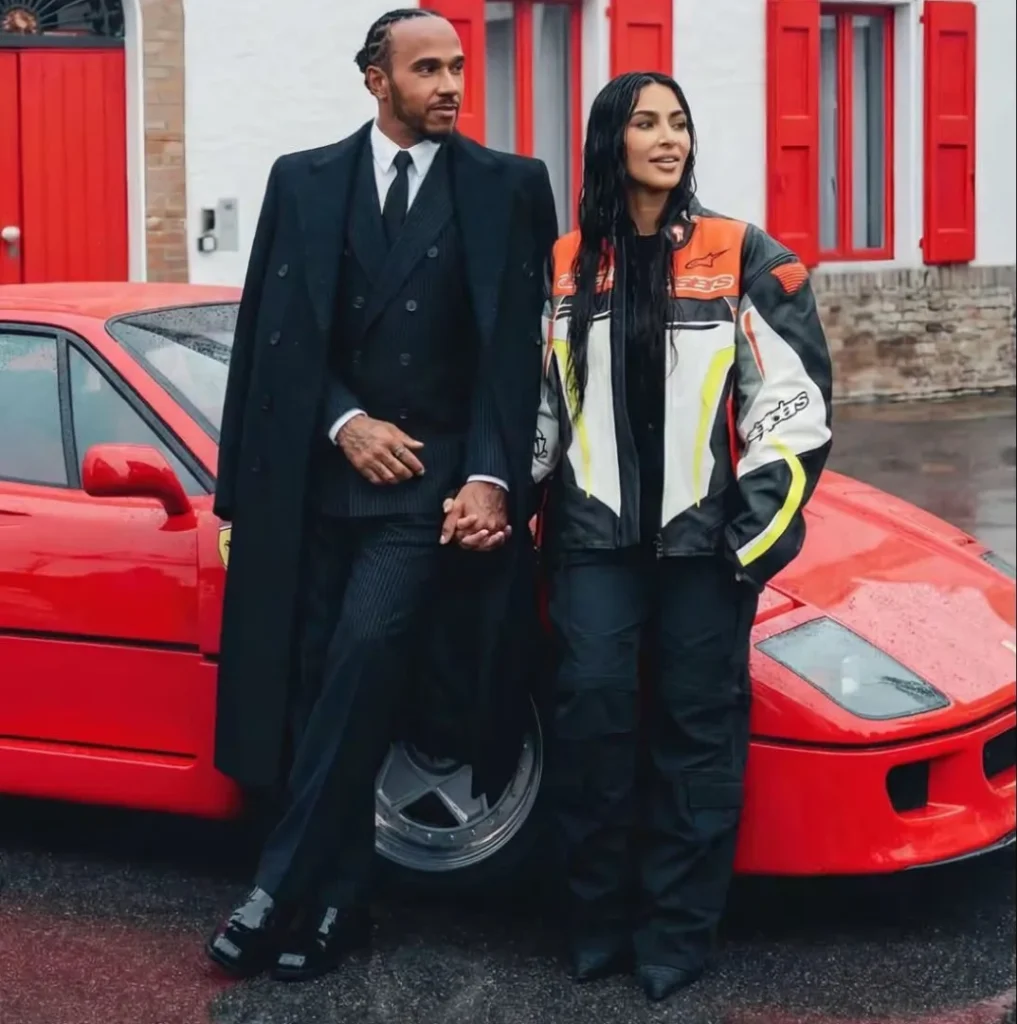
The calculus here rewards careful examination rather than romantic speculation.
For Hamilton, the Kardashian association offers something that Ferrari’s scarlet livery cannot: direct access to the most sophisticated consumer-culture distribution network in the world. The Kardashian ecosystem reaches demographics that Formula 1’s traditional audience does not. It penetrates North American popular culture at a depth that even the sport’s recent Netflix-fueled growth has not fully achieved. Hamilton has spoken extensively about his ambitions in fashion and lifestyle (his investment in brands, his celebrated front-row presence at international collections, his collaborations with Tommy Hilfiger). Visibility within Kardashian’s orbit is, functionally, a lifestyle credibility accelerant.
For Kardashian, the asymmetry runs in the opposite direction. Hamilton is, by the standards of her previous high-profile relationships, a categorically different archetype. He is internationally acclaimed but, outside the tabloid cycle that now trails the relationship, largely non-controversial. He is associated with excellence, with disciplined achievement, with a certain calibrated cool that operates in spaces (sport, fashion, philanthropy) that carry institutional respectability. His presence in her narrative does not introduce new risk. It imports credibility.
This is significant because Kardashian’s brand has long operated in a tension between mass accessibility and aspirational positioning. SKIMS, her most commercially serious venture, has worked hard to establish itself in the premium tier; it has partnered with the NBA, secured a valuation north of four billion dollars, and cultivated a customer base that extends well beyond her existing fanbase. The personal narrative that surrounds a founder affects the brands they carry. A Kardashian photographed in quiet English countryside hotels with a decorated world champion reads entirely differently from the tabloid cycles that defined earlier chapters of her personal life.
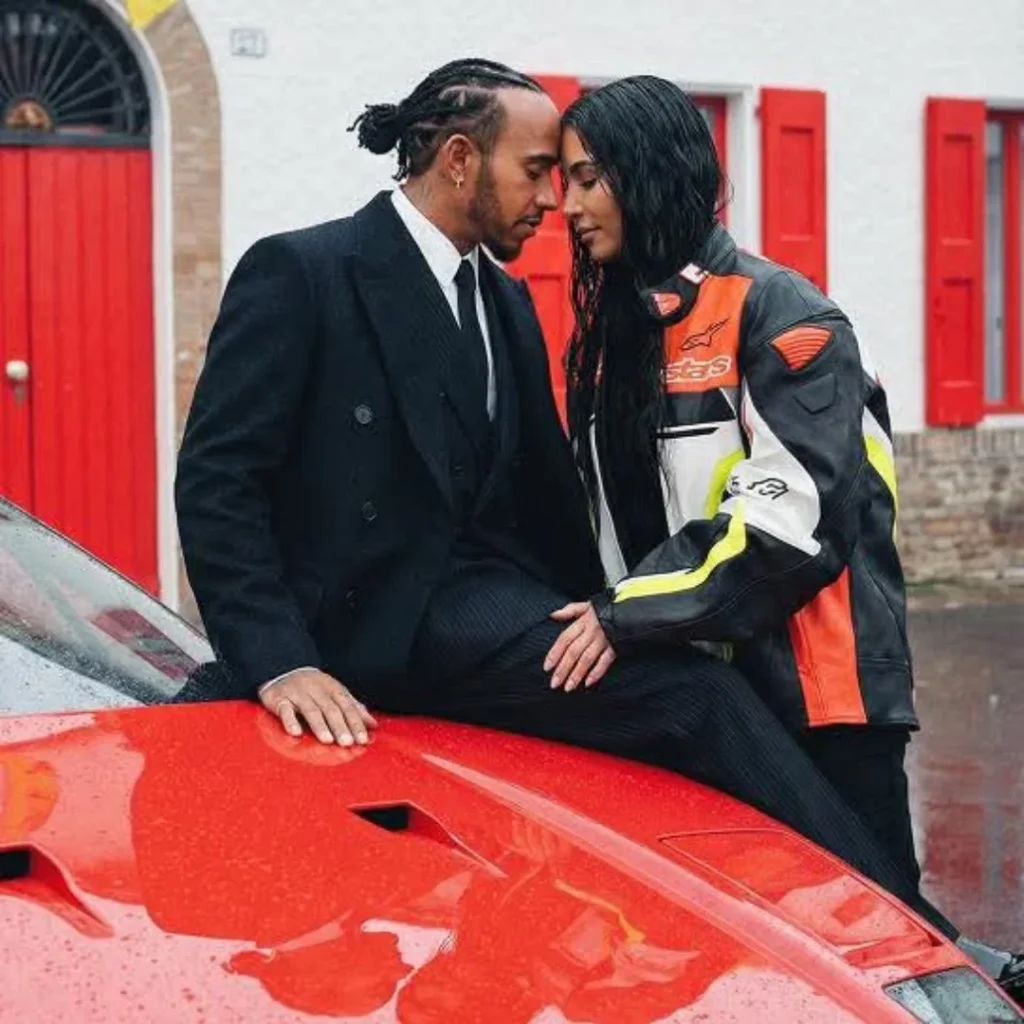
Sources characterize the arrangement, at least in its early February 2026 form, as “friends with benefits,” with Hamilton explicitly “not looking to settle down.” By early March, separate sourcing describes him as “head over heels” and the pairing as potentially “endgame.” This rapid tonal escalation in sourced coverage is itself a data point worth noting.
The deliberate deployment of relational ambiguity is a recognizable tool in contemporary celebrity management. The “not exclusive” framing generates the engagement value of a confirmed relationship (the speculation, the coverage, the audience investment) while deferring the accountability that formal commitment invites. It is a positioning that protects both parties asymmetrically: Hamilton retains the structural freedom he has explicitly signaled he requires, while Kardashian avoids the expectation architecture that a fully formalized relationship would impose on her already-scrutinized domestic narrative.
The 72-hour window between their first reported romantic outing (spanning the Cotswolds, Rosewood London, and Paris between February 1 and 3, 2026) and the arrival of international tabloid coverage is also instructive. Relationships involving figures of this profile do not reach global media saturation accidentally. The speed of disclosure, combined with the richness of sourced detail, suggests a managed release rather than a containment failure.
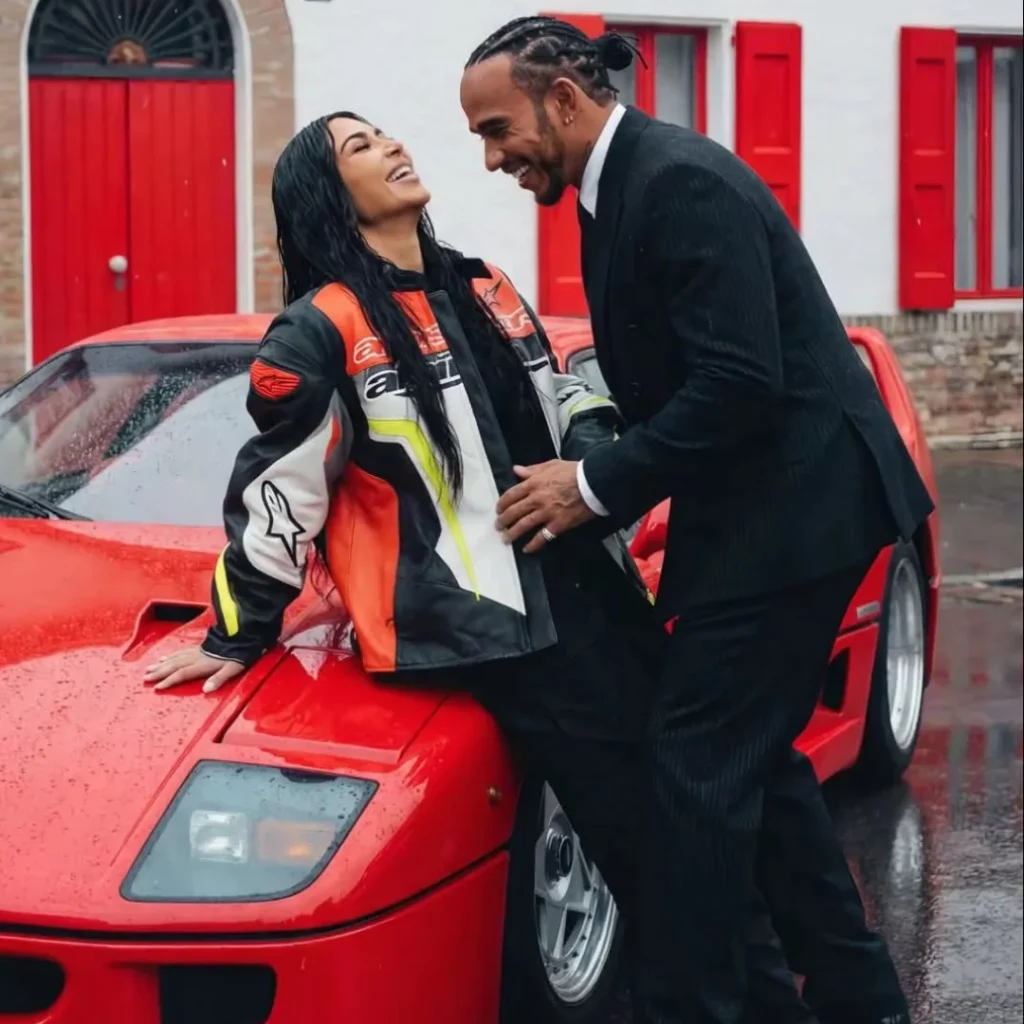
It would be reductive to suggest that strategic alignment is the entirety of the story. The documented social history between the two extends back to March 2015, when they appeared together at the Balmain Aftershow Dinner during Paris Fashion Week, and then again at the GQ Men of the Year Awards in September of the same year. A decade of social adjacency, shared industry events, and overlapping cultural circles provides the foundation upon which any present-day development is built.
What has changed is not the relationship between the individuals but the context in which that relationship now exists. In 2015, both were at different stages of their respective trajectories. Hamilton was in the middle of his dominant Mercedes era; Kardashian was at the height of the Ye chapter of her personal life. The conditions that make this moment strategically interesting for both parties did not exist then. They exist now.
The Kardashian-Hamilton convergence is a particularly clear expression of a broader shift in how elite celebrity operates at the intersection of personal life and commercial identity. The distinction between the private individual and the public brand has, for figures at this level of profile, effectively collapsed. Romantic choices, social appearances, and relationship disclosures now function within the same strategic framework as product launches, brand partnerships, and investor communications.
This is not a cynical observation; it is a structural one. Both Kardashian and Hamilton are sophisticated operators who have spent careers navigating the consequences of public exposure. It would be remarkable, at this stage of their respective careers, if either approached a high-visibility relationship without some awareness of its broader implications.
What the sourcing around this story consistently reveals is not two people swept up in unguarded feeling, but two people who are, at every level, in control of their own narratives. The “head over heels” framing and the “not looking to settle down” framing coexist in the coverage not as contradictions but as parallel messaging strategies, each serving a different audience and a different purpose.
The question that will determine the significance of this chapter for both parties is not whether the relationship deepens into formal commitment, but whether the brand value each has derived from the association can be sustained and extended independently of that outcome.
For Hamilton, the Ferrari era is only beginning. His ability to translate sporting achievement into cultural authority will depend on the lifestyle narrative he constructs around the racing career, and that narrative is now being written in real time, partly in English countryside hotels and Paris hotel suites. For Kardashian, the bar exam awaits, the SKIMS expansion continues, and the personal story she is building around serious professional ambition requires the kind of stable, respectable personal backdrop that the current arrangement, whatever its ultimate terms, has already begun to provide.
In the business of celebrity, timing is not incidental. It is the whole point. And on that measure, whatever else the Kardashian-Hamilton story becomes, its opening chapter has been, structurally speaking, close to perfect.