
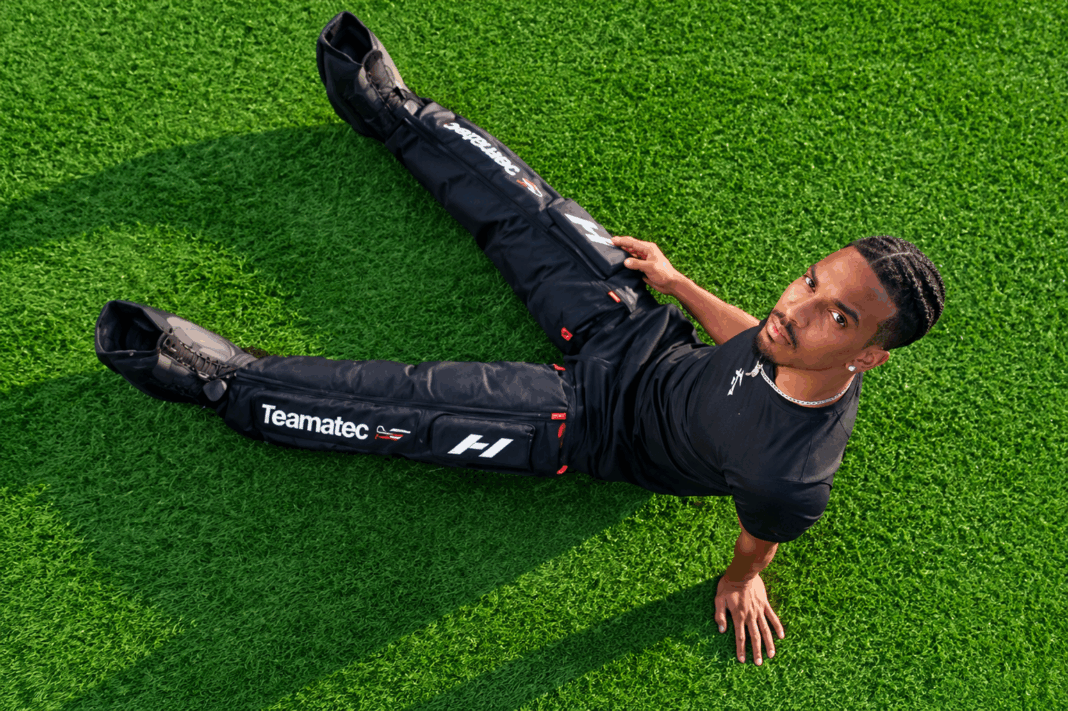
The 2026 New York City Marathon sent 61,146 finishers limping toward the subway, the hotel room, and whatever recovery ritual they had promised their quadriceps somewhere around mile 20. Four days later, Hyperice answered that collective ache with a $1,499 proposition: the Normatec Elite Heat, the first full-leg boot in its flagship Normatec line to build warmth directly into its dynamic air compression. The timing was not an accident. Recovery has become the fastest-moving frontier in fitness, and the brands competing for your tired legs are no longer selling squeeze alone. They are selling heat, vibration, and infrared light, each one wagering that a particular sensation is the feature worth more than a thousand dollars of your recovery budget.
To understand why a pair of heated boots arrives with this much anticipation, it helps to know where Hyperice sits. The Irvine company reached a reported $850 million valuation in 2024 and has spent more than a decade turning elite recovery into a consumer category, backed by an athlete-investor roster that reads like an all-star ballot: Patrick Mahomes, Naomi Osaka, Jayson Tatum, Erling Haaland. Yet roughly nine in ten of its customers are everyday users, the weekend runners and desk-bound lifters who want to recover like the professionals they watch. The Elite Heat, fronted in its launch by NFL quarterback Jayden Daniels, is built for exactly that aspirational middle.
What the boots actually do is fuse two therapies athletes have historically kept apart. Five temperature levels climb from 102 to 125 degrees Fahrenheit, paired with seven compression settings from 40 to 110 mmHg across five overlapping zones, while Hyperice’s ZoneBoost technology directs extra pressure and time wherever the ache lives. The sharper argument, though, is about timing. Heat lets the boots warm tissue before a workout as readily as they soothe it afterward. “It condenses two separate routines into one fast session,” said Gilad Jacobs, Hyperice’s chief innovation officer, a line that doubles as the company’s case for moving Normatec out of the post-run corner and into the warm-up.
Therabody, Hyperice’s most direct rival, is betting on a different set of sensations. Its $1,149.99 JetBoots Pro Plus skips heat in favor of infrared LED light and vibration layered over compression, with four chambers adjustable from 20 to 100 mmHg, eight preset programs, and three vibration intensities. In practice the vibration is the standout, lending a massage-like quality that eases stiffness in a way steady compression cannot, while the infrared, designed to work at the cellular level rather than simply warming skin, is the quieter, longer-game feature you accept more on faith. Therabody points to a 120-person study in which participants reported a 36 percent drop in perceived quadriceps pain after a single session and felt 32 percent more recovered an hour later than a passive-recovery group. Tim Roberts, the company’s chief science officer, is unusually candid about the catch, acknowledging that the study does not isolate how much the extra therapies add beyond compression on its own.
That candor points to the question hovering over this entire category. Compression boots rely on intermittent pneumatic compression, cycling pressure through the legs to coax circulation and fluid along. A 2024 review of 17 studies and 319 participants found the technology may deliver small to moderate relief for perceived soreness, even as its effect on objective recovery and performance stayed murky. The evidence for the newer flourishes is thinner still: a 2025 review of post-exercise heat returned inconsistent results, and most of it examined saunas and hot-water immersion rather than anything resembling a heated boot.
There are practical trade-offs beyond the science. The Elite Heat is fully wireless, with Bluetooth, synchronized compression, and a new button that deflates the boots in seconds, yet running heat and compression together at their highest settings drains the battery to roughly an hour, down from the ten hours that compression alone can manage. At $1,499, about $350 more than the JetBoots, it also asks runners to pay a premium for warmth. Available for preorder from November 5 with shipments the week of November 23, and an international rollout slated for early 2027, it lands a full $500 above the $999 Normatec Elite that introduced the wireless design in 2024.
After weeks of testing both devices after workouts, the honest verdict has less to do with which machine repairs muscle faster and more to do with which sensation you will actually reach for. Hyperice’s heat felt genuinely restorative as the weather turned cold, while Therabody’s vibration delivered the closest thing to a true massage. The research suggests that comfort, not miracle recovery, is what most runners are really buying, and comfort is hardly trivial. The boots you enjoy are the boots you use, and for legs that just carried someone 26.2 miles, consistency may be the most evidence-based feature of all.