
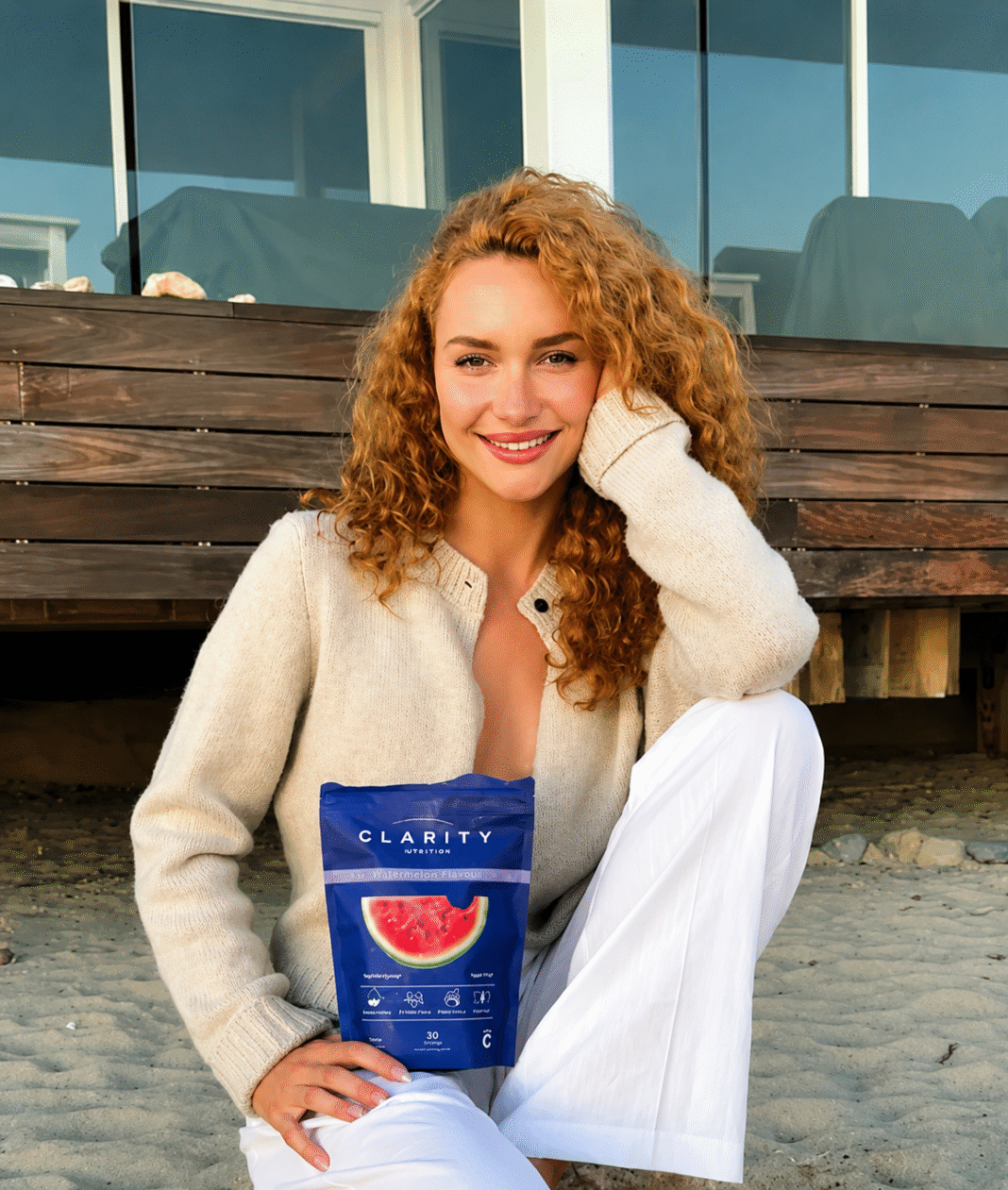
The math is almost provocative in its simplicity. Clarity Health Co., the Los Angeles hydration brand co-founded by Ana March and Beau Terwilliger, sold through 94 percent of its first inventory run without spending a single dollar on customer acquisition. In a category where the largest players, Gatorade, Powerade, and the venture-backed newcomers crowding every wellness feed, treat continuous ad spend as the cost of simply existing, Clarity did the opposite. It went quiet, and it went local, and it sold out anyway.
This is happening at a strange, crowded inflection point for hydration. The global electrolyte drinks market is projected to move from roughly 43 billion dollars in 2026 toward 82 billion by 2034, and the powder segment specifically is compounding faster than the drinks it competes with, drawing a flood of nearly identical sodium-forward stick packs into an already saturated shelf. To launch into that noise with no paid media is either naive or unusually disciplined. March, who serves as Creative Brand Director, is clear about which. “If you don’t have capital, you have to have proximity,” she says, and the line functions as both a constraint and a thesis.
What proximity looked like in practice was a schedule that reads more like a training log than a marketing plan. Clarity hydrated runners at the LA Marathon. It showed up, week after week, at run clubs including WeHo Run Club and Beaches Tropicana, the kind of standing appointments where a brand either earns its place or is quietly forgotten. At Runchella 2026, staged in partnership with Live WeHo and Lululemon, the company put product directly into the hands of the exact people it was built for, turning a sample into a conversation and a conversation into trust. “The biggest mistake early founders make is trying to look big instead of actually being embedded where their customer lives,” March says. “People buy from brands they’ve experienced, not just seen.”
Embedded is the operative word. Clarity now lives in seven curated locations across Los Angeles, among them fitness studios, the recovery haven Liv Sauna and Cold Plunge in West Hollywood, and the specialty grocer Pink Dot. It supplies chiropractors, backs local fire and police departments, and partners with communities like the LA Flag Football League, positioning the product less as a purchase than as a fixture of a day already in motion. March frames retail and community as a single move rather than two. “When your product lives inside studios, clinics, or communities that already have credibility, you inherit that trust instantly,” she says.
Then there is the athlete engine. Through its Clarity Athletes program, the brand signed high-performing college players including Gavin Doty, Donovan Isale, and Ahmad Robinson, favoring performance-driven visibility over paid endorsement. Doty’s national exposure during March Madness broadcasts generated organic awareness at a scale no small brand could purchase outright, and a broader ambassador structure lets athletes earn commissions through personalized codes, converting a scattered community into a distributed, incentivized sales force without sacrificing authenticity. “Your first customers should feel like they’re part of building the brand,” March says. “When done right, you don’t just acquire customers, you create advocates.”
The product had to be worth the trust it was borrowing. Clarity was formulated with Dr. Bhaveen Kapadia, a New York-trained physician with a background in orthopedic surgery and sports medicine, who pushed back on the category’s sodium-first orthodoxy. “Hydration isn’t simply about how much water you consume; it’s about whether your body can actually utilize it at the cellular level,” he says. The formula is built on a balanced sodium-to-potassium-to-magnesium framework, pink Himalayan salt, potassium citrate, magnesium citrate, calcium aspartate, and ionic trace minerals, each mineral assigned a job: sodium pulls fluid in, potassium distributes it into the cells, magnesium steadies the nervous and muscular systems through the cycle.
What Clarity appears to have proven, at least at the scale of a first run, is that a community-first launch compounds. The brand sold out with no acquisition cost and, more tellingly, an audience discussing the product without being prompted. The plan now is simply to do it again, replicating the same proximity to partners, events, and athletes that created the initial ripple. In a market addicted to spend, the more radical bet may be patience.