
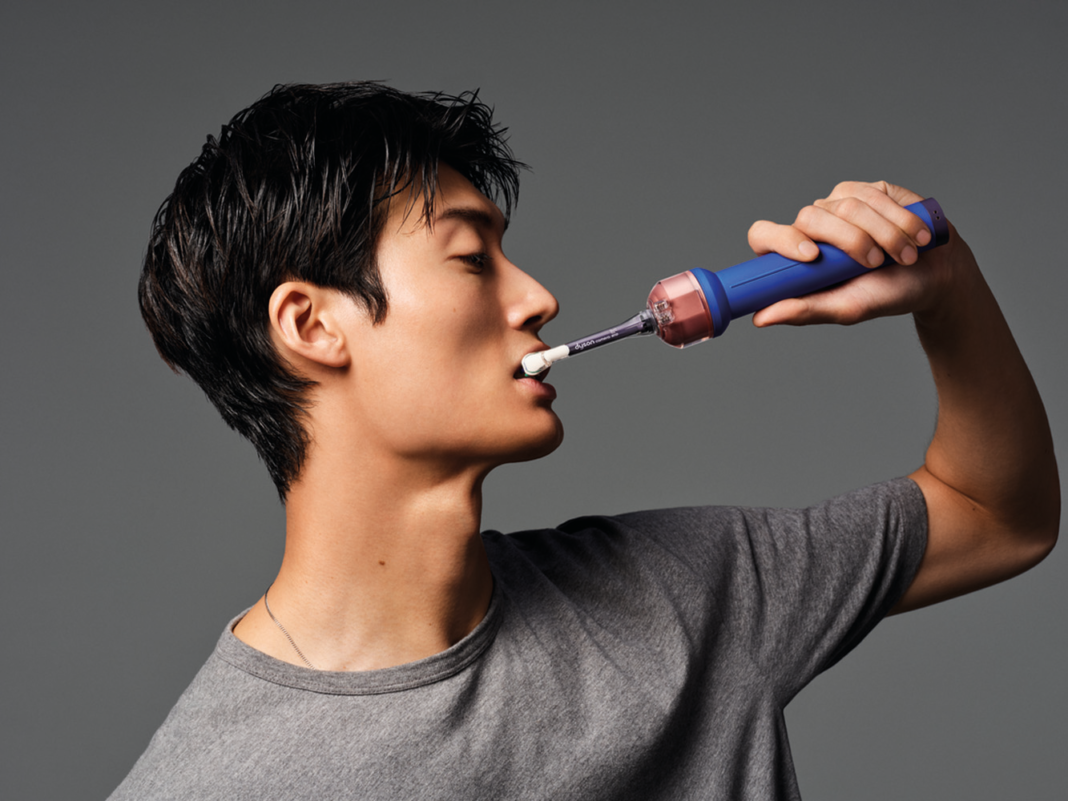
In Paris this week, James Dyson stood before an audience and did what his company has made a habit of doing: he walked into a category where he had no obvious claim and priced himself above everyone already standing in it. The object of his attention this time was neither hair nor air but the small, unglamorous ritual most of us perform twice a day and think about almost never. The Dyson CameraJet, which launched September 1 at $499, is a connected electric toothbrush with a 100,000-pixel macro camera tucked into its head, and it arrives promising to do the one thing nobody has managed to make pleasant. It wants to floss for you.
The premise is quietly audacious. As you brush, an integrated camera captures 28 live images per second, feeding them to a machine-learning system Dyson calls Gap Optical Targeting. When the software recognizes a space between two teeth, the place where plaque first forms and then hardens, it fires a conical burst of mouthrinse at the gap within roughly 100 milliseconds. The targeting model was trained on 470,000 dental images, and the whole apparatus is the product of six years of work by, per Dyson’s own accounting, 661 engineers. This is a great deal of computational firepower aimed at the crevices of the human molar.
What makes the story more than a spec sheet is the man behind it, and his refreshingly ordinary motivation. Dyson has said the entire project grew out of a personal grievance shared by millions: he hates flossing. He knew water flossers existed, found most of them ineffective at actually clearing the interdental spaces, and turned his company’s expertise in fluid dynamics and computer vision toward a problem dentists have been nagging patients about for a century. There is something almost comic about summoning artificial intelligence to solve a problem that a length of waxed string was invented to address in 1815, and yet the compliance data suggests the string has lost. Most people simply do not floss, and no amount of scolding at the six-month cleaning has changed that.
The engineering claims, for their part, are specific enough to take seriously. Dyson says external testing showed the CameraJet’s variable sonic oscillation removed up to 69 percent more plaque in hard-to-reach areas than market-leading premium electric toothbrushes, with the proxy plaque developed through research with the National University of Singapore. The company is careful to note that camera images are processed on the device itself and are neither stored nor shared, a reassurance that feels necessary the moment you absorb that there is a lens pointed at the inside of your mouth.
To keep that lens working, Dyson has engineered an entire supporting cast: a proprietary toothpaste formulated without sodium lauryl sulfate, the common foaming surfactant, alongside a low-foaming mouthrinse, both designed to keep suds out of the camera’s field of view. You can use the device with any brand you like, though Dyson concedes you may not get a full hit rate without the reduced-foam formulas. This is where the real math surfaces. Each brush head carries an RFID tag that tracks usage and prompts replacement, and annual spending on Dyson consumables could approach $200, which puts the five-year cost of ownership well past $1,400 before you replace the handle at all.
That figure is the actual news, and the incumbents in every drugstore in America will register it even if they lose no immediate market share. Dyson has demonstrated, again, that a household with disposable income will accept a subscription-shaped relationship with an object it once bought for four dollars. Whether the rest of us decide our teeth are ready for their close-up is the question the next year will answer.