
What if the most subversive thing a person in America could do right now is simply buy a ticket?
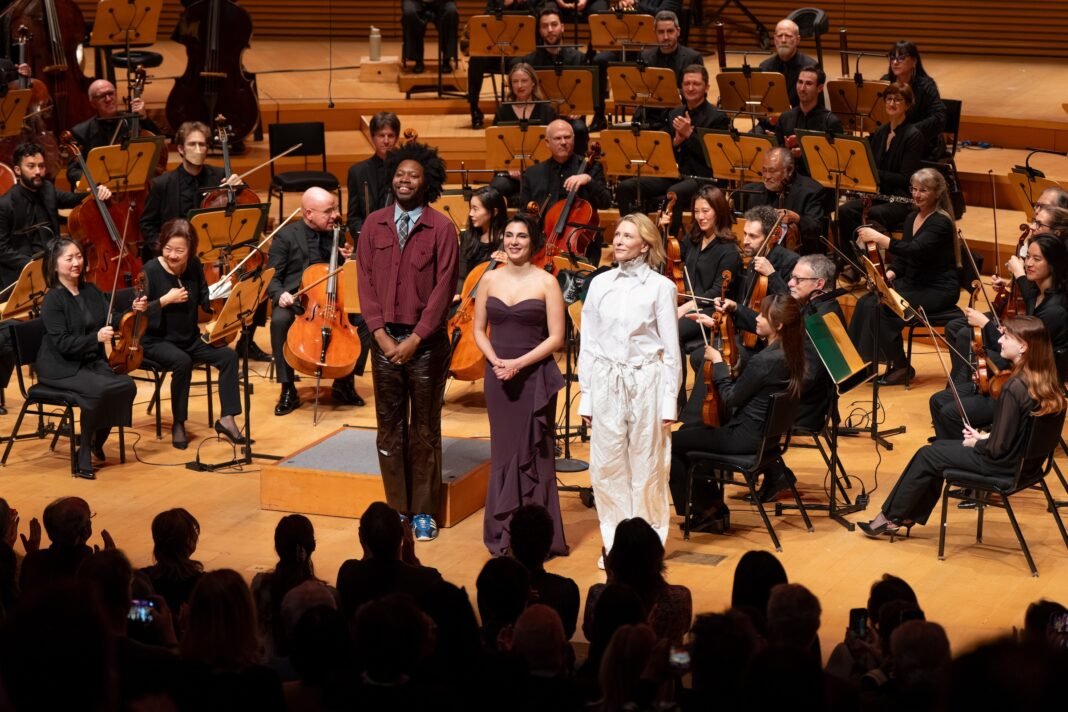
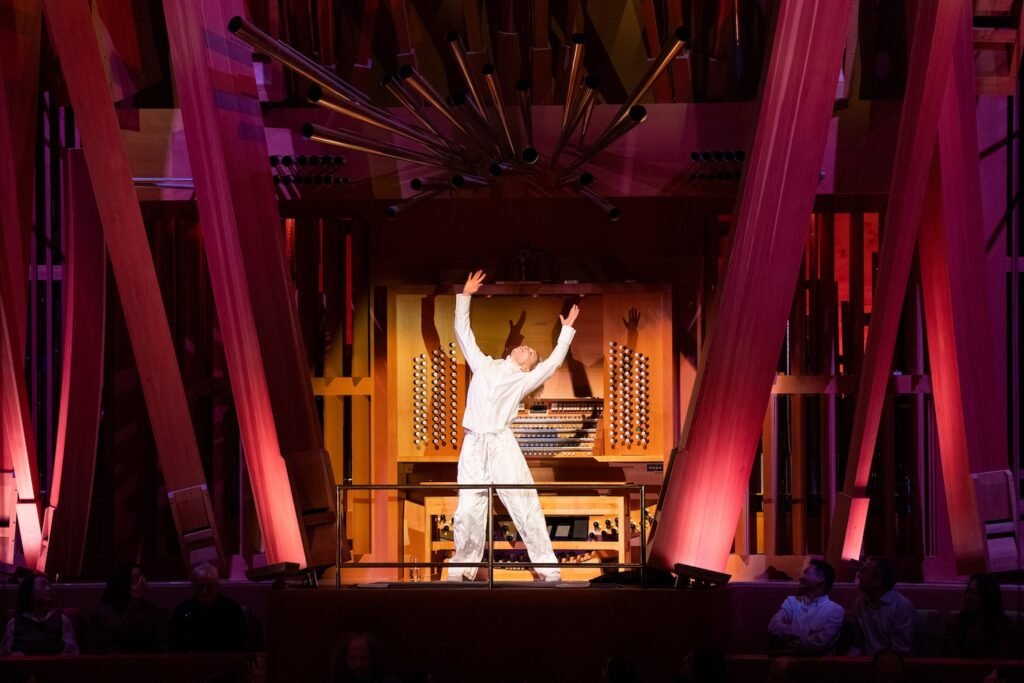
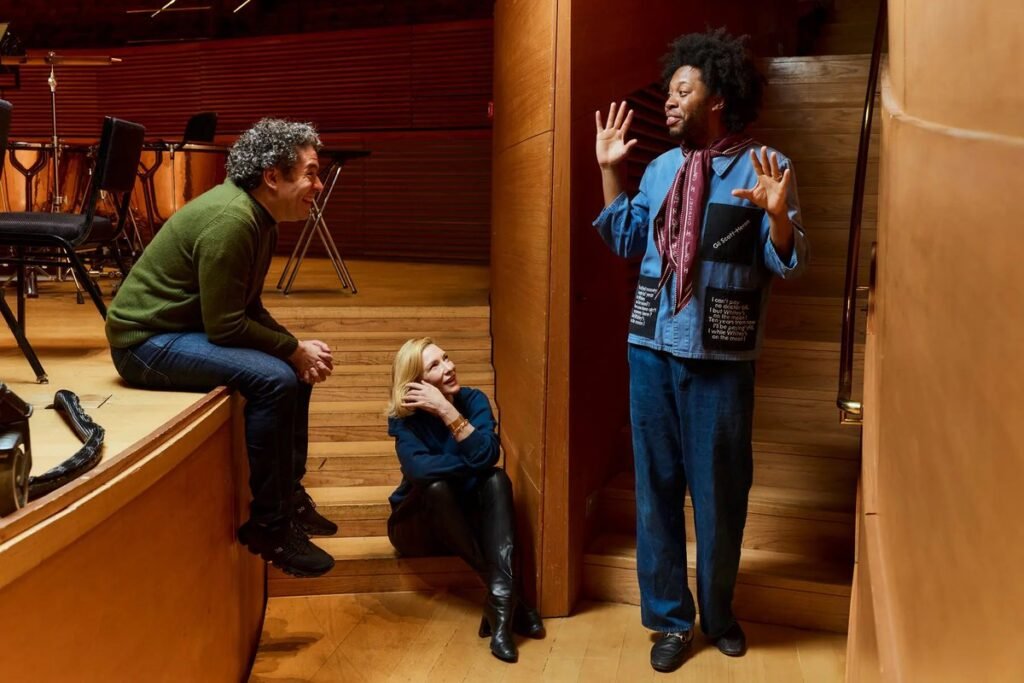
That is not a metaphor. When Jeremy O’Harris — the playwright behind the incendiary Slave Play — took the stage at Walt Disney Concert Hall last week alongside Cate Blanchett and conductor Gustavo Dudamel, he wasn’t merely presenting a reinvention of Goethe’s 18th-century political drama Egmont. He was issuing a quiet manifesto. In conversation after the performance, O’Harris made an argument that cuts against the entire logic of contemporary activism: that social media, the default terrain of modern dissent, is infrastructure built and owned by the very forces it purports to challenge. The theater, by contrast — untracked, embodied, communal — may be the last genuinely free space left. “Come to the theater,” he said. “Plan the revolution there.” At a moment when arts funding is in crisis across America and attention is the most coveted commodity on earth, O’Harris’s provocation arrives with the full weight of a 300-year-old score behind it.
The argument O’Harris is making is not new. But the precision and the platform with which he is making it are. For years, cultural theorists have warned about what surveillance capitalism does to political consciousness: it monetizes dissent, fragments solidarity, and routes every act of resistance back through an algorithm designed to generate engagement rather than action. What is new is that a mainstream playwright, standing inside one of America’s most prestigious concert halls, is saying it out loud, directly, to an audience that paid to be there.
This is significant because it represents a visible crystallization of a quieter, longer trend. Across the cultural landscape, a growing number of artists, organizers, and intellectuals are making a deliberate turn back toward the analog and the in-person, not out of nostalgia, but out of strategic intent. The logic runs as follows: if the platforms that dominate digital life are increasingly controlled by actors aligned with concentrated economic and political power, then those platforms cannot serve as the infrastructure for genuine opposition. The feed can be curated, the account suspended, the hashtag buried. The room cannot.
O’Harris’s adaptation of Egmont makes this argument not just rhetorically but formally. By collapsing linear time in his text and placing Goethe’s 18th-century martyr figure into what he describes as a “prophetic perfect tense,” he draws explicit lines between the Spanish occupation depicted in the original drama and contemporary crises in Gaza, Ukraine, and Minneapolis. The technique is deliberate: it asks the audience to understand that the authoritarian dynamic Goethe was writing about in 1788 is not historical curiosity but a recurring structural condition. The villain, in other words, has not changed. Only the interface has.
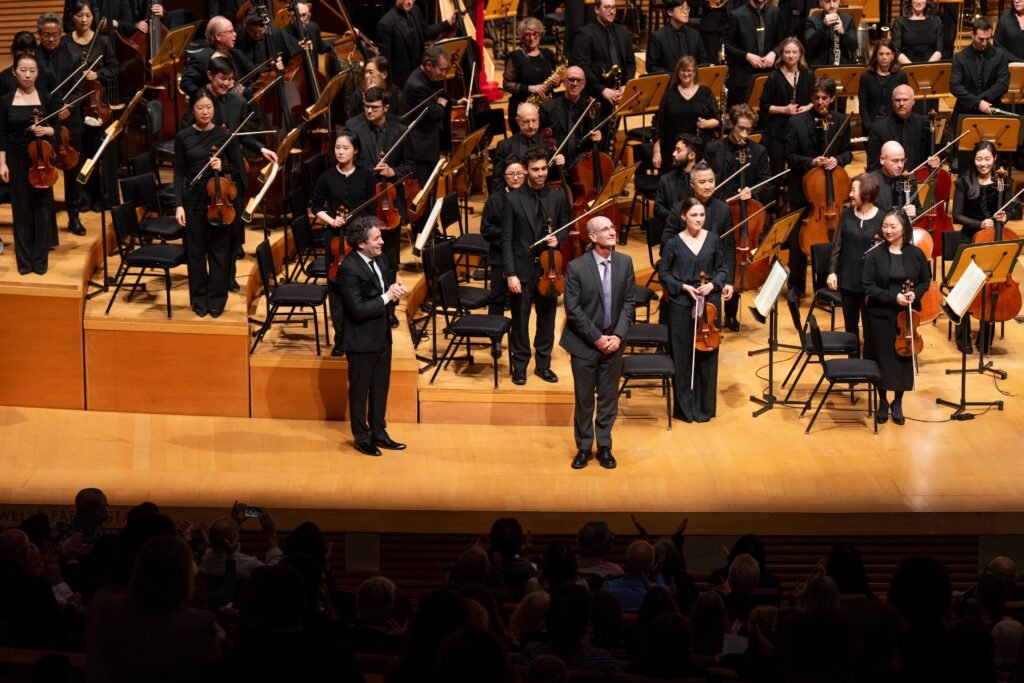
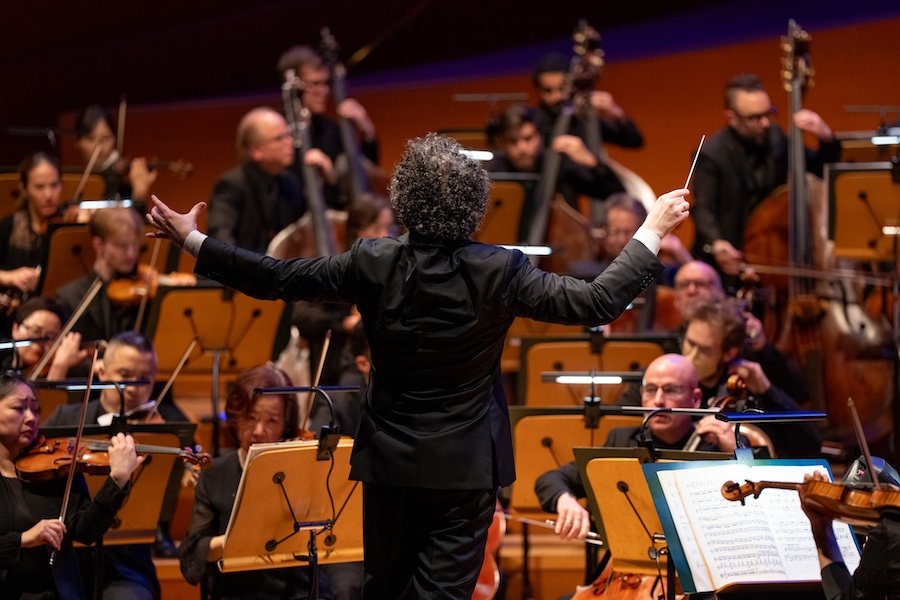
The production’s formal choices reinforce this reading. Gustavo Dudamel, the Los Angeles Philharmonic‘s Music and Artistic Director, conducted Beethoven’s Egmont, Op. 84, a score he has described as personally significant since the age of twelve. Cate Blanchett, cast in the gender-swapped titular role, served as narrator. Soprano Elena Villalón completed the principal lineup. The combination of classical score, theatrical narration, and contemporary textual intervention created something that resists easy categorization — which may be precisely the point. Work that cannot be filed away cleanly is work that continues to operate on the audience after they leave the hall.
The broader cultural moment that makes O’Harris’s argument land so forcefully is one of acute institutional fragility. Arts funding across the United States is under sustained pressure. Federal support for the arts has faced repeated legislative challenges; state and municipal arts budgets have been among the first casualties of fiscal tightening. Orchestras that survived the pandemic now operate under endowments stretched thin by inflation and donor fatigue. In this context, the theater’s claim to being a “free space” carries a layer of irony that O’Harris himself would likely acknowledge: it is a free space with a ticket price, housed inside a building that requires significant philanthropic subsidy to remain open.
Yet this tension does not undermine the argument so much as complicate it usefully. The question is not whether the concert hall is perfectly democratically accessible — it is not, and the performing arts sector has long grappled with the structural exclusions that ticket prices and cultural capital impose. The more pointed question is about the nature of the space itself, as distinct from the nature of access to it. Inside that space, something different happens. The experience is shared in real time, in a single physical location, with no algorithm mediating what each person sees. There is no engagement metric being harvested. There is no targeting. The room is, in the strictest technical sense, opaque to the surveillance infrastructure that governs almost every other space in which public discourse now takes place.
Industry observers have noted that this quality, once taken entirely for granted, is increasingly rare and increasingly valued. The dramatic growth of live performance markets in the post-pandemic period points toward something beyond simple pent-up demand. Audiences are not merely returning to theaters and concert halls because they missed the experience. Many are returning because the experience offers something they cannot find on a screen: the specific political and social electricity that comes from being physically present with other people who have chosen, collectively, to pay attention to the same thing at the same time.
O’Harris’s case against screen-mediated activism is, at its core, a case for shared attention as a precondition for genuine political community. Social media produces awareness; it has proved far less reliable at producing solidarity. The Arab Spring, once held up as proof of the organizing power of platforms, generated a more sobering long-term lesson: movements built on digital infrastructure are vulnerable to the withdrawal, manipulation, or capture of that infrastructure by hostile actors. Physical community, by contrast, persists below the threshold of algorithmic visibility.
This is why the choice of Egmont as vehicle is so loaded. Beethoven’s score was written to accompany a story about a man who chose public martyrdom over private accommodation with power, and whose death was explicitly framed as a catalyst for collective resistance rather than an endpoint. O’Harris’s adaptation does not soften this. It sharpens it, by insisting on the contemporaneity of the dilemma. The question Egmont poses — whether to comply with a system that will destroy you regardless, or to act in full knowledge of the cost — is one that resonates with particular force at a moment when the terms of digital participation are being rewritten by the very figures whose power those platforms consolidate.
The LA Philharmonic’s willingness to program this work, in this form, with this collaborator, signals something about where at least some major institutions believe their future lies: not in the careful stewardship of cultural prestige, but in the willingness to become a site where the present is actively contested. Whether that bet will sustain audiences, donors, and the institutional health required to keep the doors open is a question that will take years to answer. But O’Harris’s provocation, issued from one of the most acoustically perfect rooms in America, has already done what the best political art is supposed to do. It has made staying home feel like a choice with consequences.