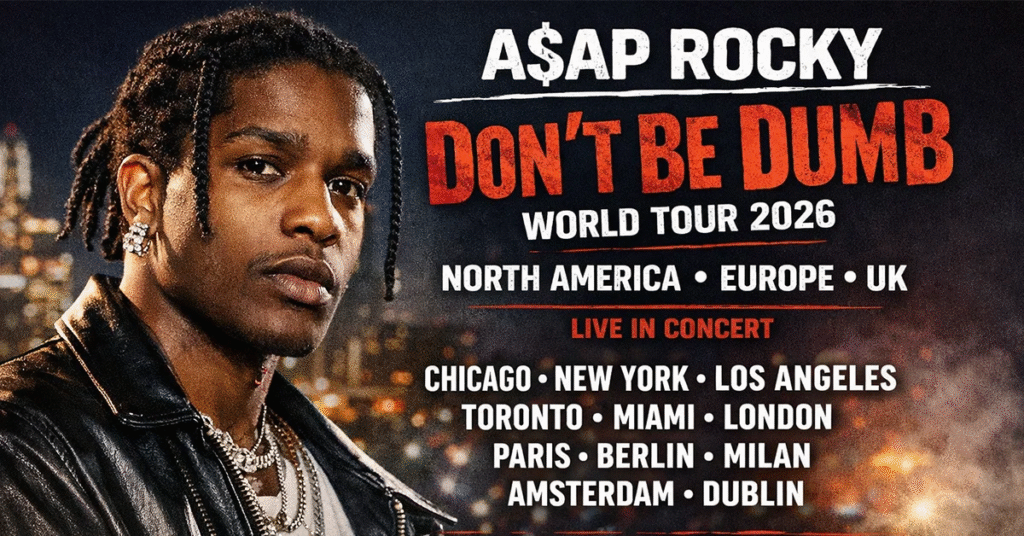
In the attention economy of modern music, eight years is an eternity. Artists are expected to release albums annually, drop singles constantly, and maintain an unrelenting social media presence just to remain visible. Yet A$AP Rocky—who hasn’t released a studio album since 2018’s “Testing”—just announced a 42-date arena tour spanning two continents, betting that scarcity, not saturation, is the new currency of cultural relevance. The “Don’t Be Dumb World Tour” isn’t just a victory lap for his latest album; it’s a stress test of whether established artists can abandon the album-tour-album treadmill entirely, building value through fashion collaborations, business ventures, and selective appearances while their music catalog appreciates like fine wine. In an industry where streaming pennies have made touring the primary revenue stream, Rocky’s extended absence poses a provocative question: Has he discovered the optimal formula for maximizing both cultural capital and financial return?
The numbers tell a compelling story about the economics of patience. Rocky’s “Don’t Be Dumb World Tour,” promoted by Live Nation and launching May 27, 2026, in Chicago before concluding September 30, 2026, in Paris, represents a massive arena-level undertaking for an artist who has spent nearly a decade away from the album cycle. The 42-date itinerary spans major North American markets, Canadian cities, and a comprehensive European leg that includes both established markets like London and Paris alongside emerging Eastern European venues in Riga, Kaunas, and Lodz. This move signals a fundamental shift in how established artists approach career longevity: rather than chasing algorithmic relevance through constant releases, Rocky has positioned himself as a cultural institution whose rare appearances command premium attention.
The financial implications are particularly striking when examined against industry economics. In the streaming era, album sales have become largely symbolic—a 2025 industry analysis revealed that even platinum-certified albums generate relatively modest direct revenue for artists after label recoupment and platform fees. Touring, by contrast, has become the primary income driver for established acts, with artists retaining significantly higher percentages of gross revenue from ticket sales, VIP packages, and merchandise. Rocky’s tour incorporates all these revenue streams: multiple presale tiers including an artist presale beginning January 23 for North America and January 21 for Europe and the UK, a Cash App Card exclusive presale for U.S. dates, and general on-sale January 27, 2026. The VIP packages offer behind-the-scenes access, premium seating, pre-show lounge access, and limited-edition merchandise—a multi-tiered strategy designed to maximize revenue per attendee.
This is significant because Rocky’s eight-year gap may have actually enhanced, rather than diminished, his touring potential. During his musical hiatus, he strategically built equity in adjacent industries that traditional album cycles would have made impossible to pursue. His fashion collaborations—ranging from partnerships with major luxury brands to his own creative ventures—have kept him visible to a demographic that values cultural credibility over chart position. His business investments and high-profile personal life have maintained tabloid relevance without requiring musical output. The result is an artist who enters 2026 with both nostalgic appeal to longtime fans and contemporary relevance to younger audiences who know him as much for his cultural presence as his discography.
Industry experts suggest this model represents a broader recalibration of artist economics in the post-streaming landscape. The traditional major-label playbook demanded constant content generation to maintain radio airplay and retail presence—mechanisms that streaming has largely rendered obsolete. Today’s artist can remain culturally relevant through strategic brand partnerships, social media engagement, and selective high-profile appearances while allowing their catalog to generate passive streaming income. When they do return with new material, the scarcity creates event-level interest rather than routine consumption.
The tour’s scale also reveals how pent-up demand translates into booking power. Securing 42 arena dates across two continents requires demonstrated ticket-moving ability, and Live Nation’s commitment to this tour suggests confidence that Rocky’s extended absence has created genuine market hunger. The inclusion of two major festival performances—Governors Ball and I-DAYS—further validates this calculus, as festival bookers notoriously prioritize acts with proven draw and cultural momentum.
The Cash App Card exclusive presale deserves particular scrutiny within this economic framework. This partnership represents a shift from traditional credit card company presales toward fintech platforms targeting younger, mobile-first demographics—precisely the audience that has sustained Rocky’s relevance during his album hiatus. For Cash App, exclusive ticketing access becomes a loyalty tool and user acquisition strategy. For Rocky and Live Nation, it provides a distribution channel aligned with their core demographic while potentially offering more favorable revenue-sharing terms than traditional sponsorships.
What Rocky’s strategy ultimately reveals is a maturation of the artist-as-enterprise model. Rather than viewing albums as products and tours as promotional vehicles, he has inverted the relationship: cultural presence is the product, albums are the catalyst, and tours are the monetization event. The eight-year gap wasn’t creative paralysis or commercial miscalculation—it was strategic patience, allowing cultural capital to accumulate while diversifying revenue streams beyond music entirely.
The broader implications extend beyond Rocky’s individual career trajectory. If this model proves financially successful—and the arena-level ambition suggests confidence that it will—it could fundamentally alter major-label artist development strategies. Instead of pressuring established acts to maintain constant output, labels might encourage selective releases timed to maximize cultural impact and touring revenue. The album becomes less a standalone product and more a periodic reset of cultural relevance, a reason to re-engage audiences who have remained aware of the artist through non-musical channels.
This approach also addresses the creative burnout that has plagued artists forced into perpetual release cycles. By decoupling financial stability from annual album requirements, established artists can approach projects with greater creative ambition rather than commercial urgency. Rocky’s “Don’t Be Dumb,” released January 17, 2026—his first studio album since “Testing”—arrives without the desperation of an artist clinging to relevance, but rather as a statement from someone who has spent eight years building leverage.
The “Don’t Be Dumb World Tour” ultimately represents more than a comeback—it’s a proof of concept for a post-streaming artist economy where cultural omnipresence matters more than musical productivity, where quality and scarcity command greater premiums than quantity and accessibility, and where the artist who knows when not to release may be more strategically sophisticated than the artist who never stops. As the tour launches in Chicago on May 27, the industry will be watching closely to see whether Rocky’s eight-year gamble pays off—and whether it establishes a new playbook for how established artists maximize both their artistic integrity and their financial returns in an era where the old rules no longer apply.